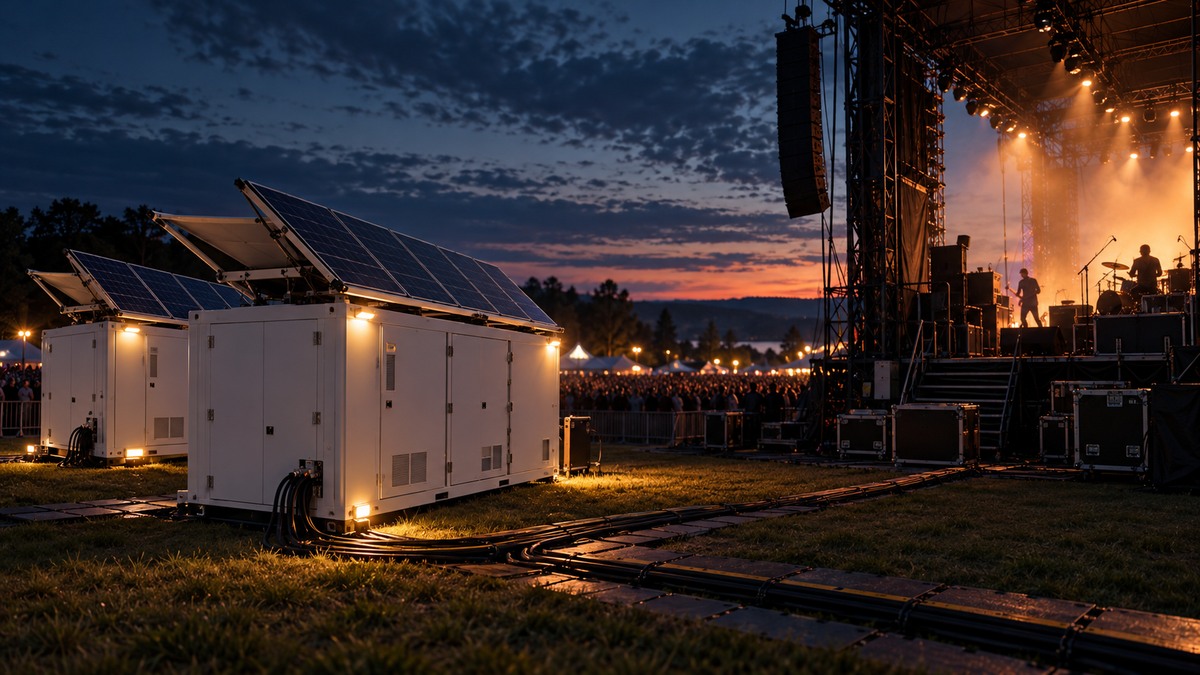
Every electricity grid runs on a daily price swing. In the middle of a sunny day, when solar generation floods the system, wholesale power can be almost free — occasionally it is priced below zero. On a hot evening, when air conditioning peaks just as the sun disappears, the same kilowatt-hour can cost several times as much. That spread between cheap hours and expensive hours is not a market glitch. It is a durable feature of how grids work — and battery storage is the machine built to earn from it.
Arbitrage, in one sentence
Energy arbitrage is the practice of acquiring electricity when it is cheap — buying it off-peak, or generating it from your own solar array at midday — storing it in a battery, and then using or selling it during the hours when electricity is expensive. Buy low, sell high, with a battery instead of a trading desk.
What makes this practical in 2026 is not the concept, which is as old as pumped hydro, but the hardware. A containerized lithium iron phosphate (LFP) battery system charges and discharges daily for years, responds to a price or outage signal in under 50 milliseconds, and is run by an energy management system (EMS) that reads solar forecasts, load profiles, grid signals, and market prices — then decides, automatically and continuously, whether to charge, hold, discharge, or export.
The two sides of the meter
Behind the meter: shrinking the bill
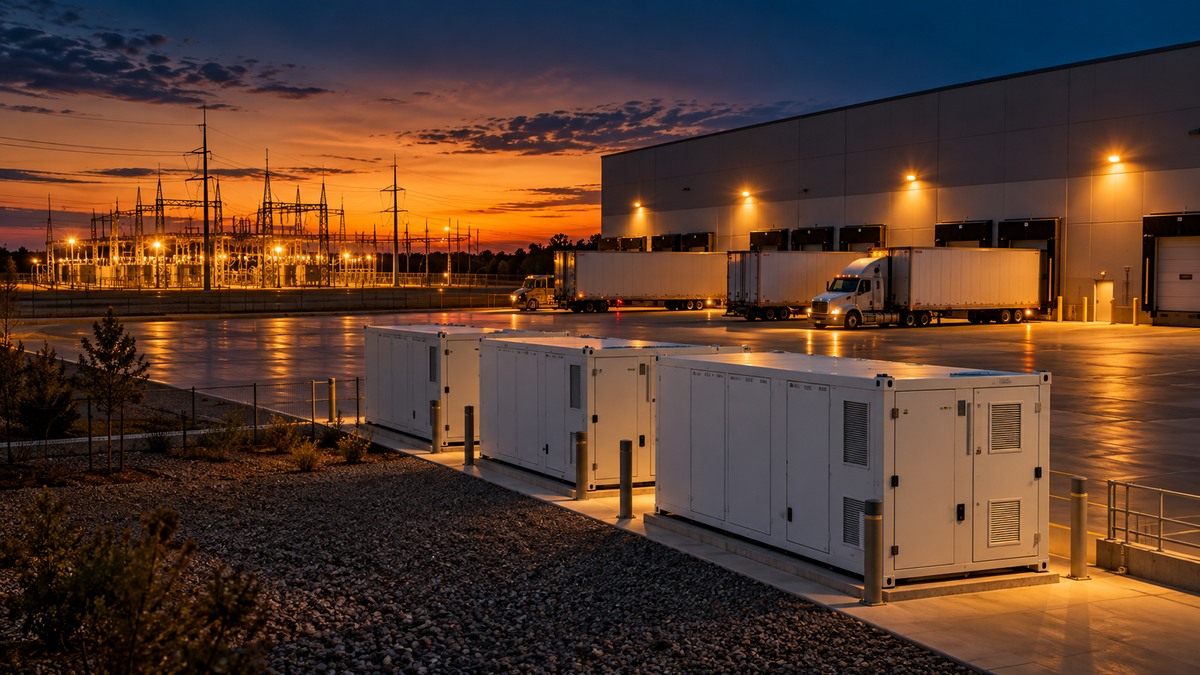
Most commercial operations first encounter arbitrage behind the meter — on their own side of the utility connection. Two mechanisms do the work. Time-of-use arbitrage charges the battery when rates are low, or from on-site solar whose marginal kilowatt-hour is effectively free, and discharges it through premium evening hours. Demand-charge management goes after a cost many operators underestimate: utilities bill commercial customers for their single highest short-term draw of the month, so the moment a large pump, chiller, or motor bank starts is often the most expensive moment on the bill. A battery that shaves that peak, even for a few minutes, cuts a charge that would otherwise recur every month.
In front of the meter: selling to the grid
Configured grid-interactively, the same system can export — earning revenue from energy sales, capacity payments, frequency regulation, and demand-response programs. Because batteries respond faster than any thermal plant, grid operators increasingly pay for exactly the service storage is best at: being instantly, precisely available.
A day in the life of an arbitraging battery
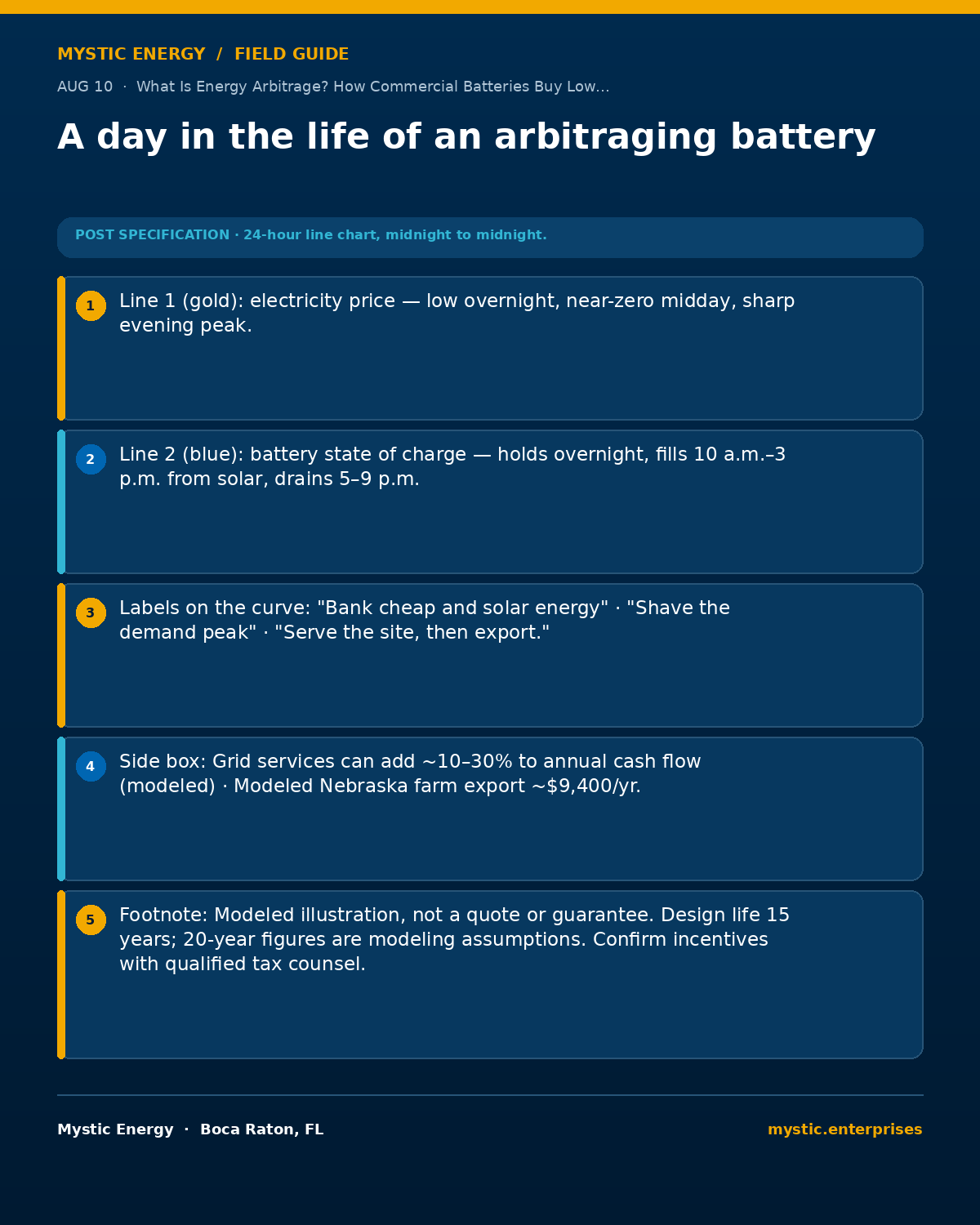
The rhythm is simple. Overnight, the battery holds its reserve and, where tariffs allow, tops up on cheap off-peak power. From mid-morning, on-site solar serves the operation directly while the surplus charges the battery — energy banked at near-zero marginal cost. In the late afternoon and evening, when rates and demand peak together, the EMS discharges: serving the site’s own load first, shaving the demand peak, and exporting whatever the tariff pays for. The operator does nothing; the EMS runs the trade every day, and reports what it earned.
What the strategy earns
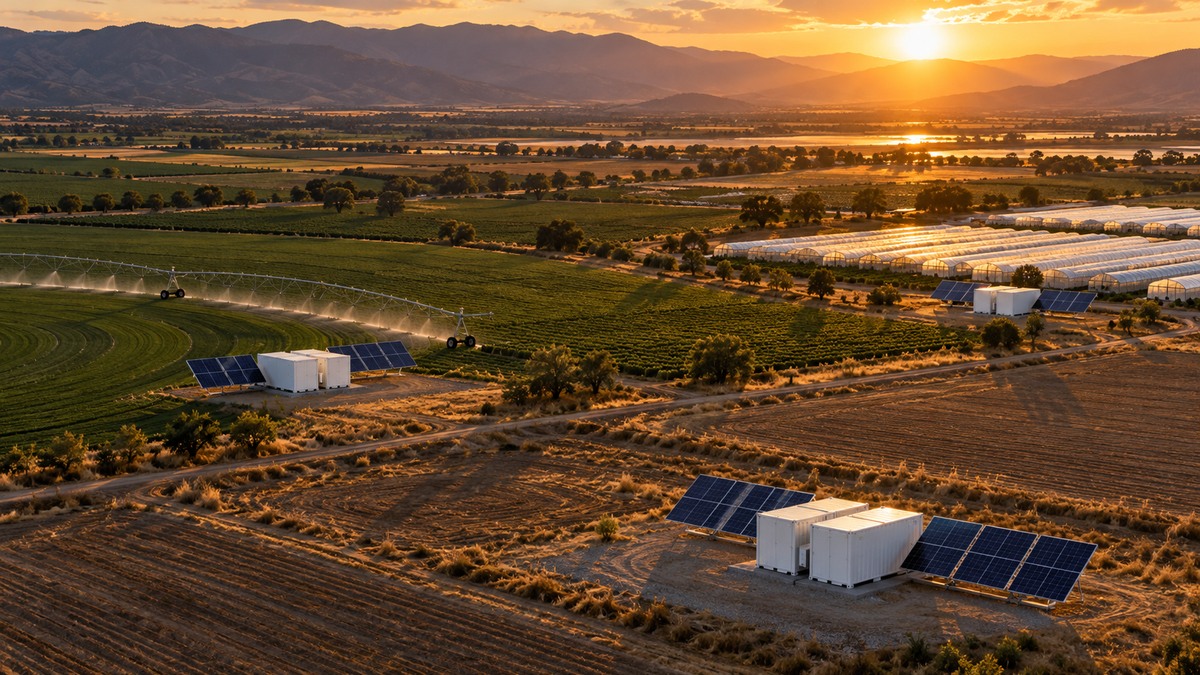
The honest answer: it depends on your tariff and your market — and every figure that follows is a modeled illustration, not a quote or a guarantee. In our platform modeling, energy value is the base of the stack, whether as avoided grid purchases or exported power, and ancillary revenue streams can add roughly 10 to 30 percent to annual cash flow on top, depending on market design. In our agricultural modeling, a mid-size Nebraska irrigated farm‘s deployable node exports its midday surplus for an estimated $9,400 per year — while delivering energy to the operation itself at approximately 1.8¢ per kWh over a 20-year modeling horizon, against a rural grid average near 16.7¢. Note that the hardware’s stated design life is 15 years; 20-year figures are modeling assumptions. A site-specific assessment replaces the model’s assumptions with your actual loads, tariffs, and market rules.
Why the economics turned in storage’s favor
Global turnkey battery-system prices fell to roughly $117 per kilowatt-hour in 2025 — a 31 percent decline in a single year and the lowest level on record — and the levelized cost of storage is now below $100 per megawatt-hour in several markets, making dispatchable batteries cheaper there than new-build gas generation. The U.S. incentive picture also favors storage specifically: standalone battery storage remains eligible for the 30 percent federal Investment Tax Credit through 2032, a materially longer runway than solar generation credits, which face 2026–2027 begin-construction and in-service deadlines. Tax and incentive treatment is structure-dependent and subject to change — always confirm current eligibility and timing with qualified tax counsel.
Frequently asked questions
Is energy arbitrage only for utilities and traders?
No. Any commercial operation on a time-of-use tariff or demand-charge schedule performs arbitrage the moment it installs storage — the EMS simply does the trading against your own bill instead of a wholesale market. Selling into grid markets is a further step, available where local market rules and interconnection allow.
What does “behind-the-meter” mean?
Storage installed on the customer’s side of the utility meter, serving on-site loads first. It changes what you buy from the grid and when you buy it. Front-of-the-meter assets, by contrast, connect directly to the grid and sell into wholesale markets.
Doesn’t daily cycling wear the battery out?
Daily cycling is what LFP chemistry is engineered for — it tolerates deep charge-discharge cycles with a long cycle life, which is why it has become the standard for commercial and grid-scale storage. Our systems carry a stated design life of 15 years, with cell health managed continuously by the battery management system.
Are the revenue figures guaranteed?
No. Tariffs, market rules, and export compensation vary by utility and can change. The figures in this article are modeled illustrations, and our sizing practice is deliberately conservative: the core economics must stand on avoided cost alone, with market revenue treated as upside rather than the foundation of the payback.
Put the price spread to work
If your operation pays demand charges, a time-of-use tariff, or a diesel bill, the spread is already on your ledger — storage just moves it to your side of the table. See how our containerized systems capture it on the commercial battery storage page, explore the wider renewable energy platform, or request a site-specific assessment and we’ll model your tariff, loads, and market. Mystic Energy — Boca Raton, FL · +1 (762) 316-5592.