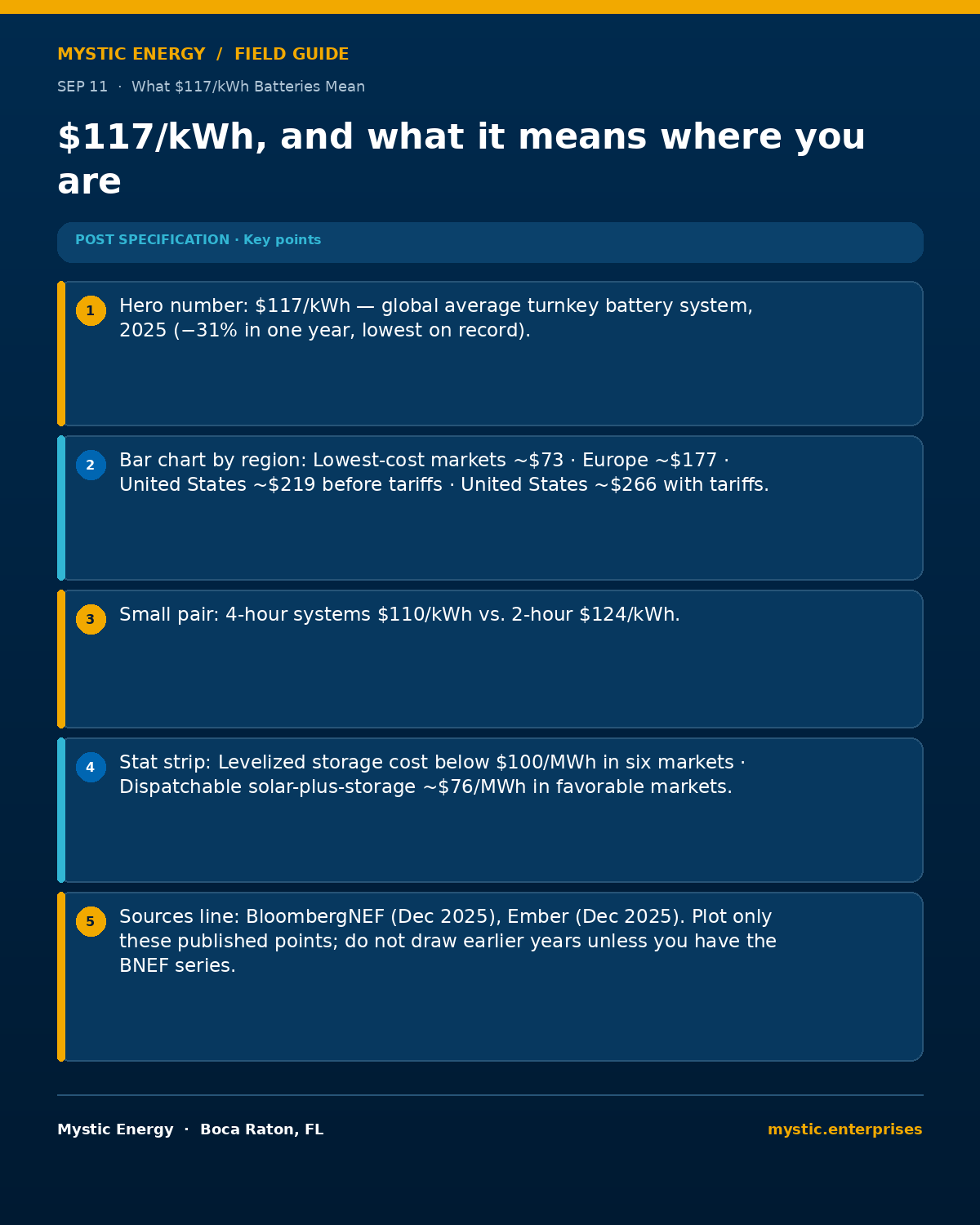
Once a year, an industry number comes along that quietly rewrites every spreadsheet built on the old one. For energy storage, the latest is $117 per kilowatt-hour — BloombergNEF’s December 2025 figure for the global average price of a turnkey battery energy storage system. That is a 31 percent drop in a single year, and the lowest level recorded since the survey began in 2017.
Headline numbers invite lazy conclusions, so this post does the more useful thing: explains what the figure actually measures, where it does and does not apply, and what it changes for anyone weighing a commercial storage or solar-plus-storage project in 2026.
What the number measures
The $117/kWh figure is BloombergNEF’s global average for turnkey systems — not bare battery cells, but the full delivered package: cells, racks, power conversion, battery management, thermal control, fire suppression, and enclosure. That distinction matters, because the turnkey figure is the one that flows into project budgets. A 500 kWh system priced at the global average implies storage hardware in the tens of thousands of dollars, not the hundreds — a sentence that would have read as fantasy five years ago.
Two forces drove the 31 percent fall: cell prices declining on manufacturing scale, and intense competition among system integrators. Ember’s December 2025 analysis reached the complementary conclusion: dispatchable solar-plus-storage now prices around $76 per megawatt-hour in favorable markets — cheaper and faster to build than equivalent new gas capacity.
Where the average does and doesn’t apply
Averages hide geography, and in 2025 the geography was dramatic. BloombergNEF’s survey put the lowest-cost markets near $73/kWh, Europe around $177/kWh, and the United States at roughly $219/kWh before tariffs — approximately $266/kWh once the current U.S. tariff regime is factored in. Duration matters too: four-hour systems averaged $110/kWh against $124/kWh for two-hour systems, since the fixed balance-of-plant spreads across more energy capacity.
The practical reading for U.S. buyers: the global curve tells you where the technology is going; your delivered price depends on trade policy and sourcing. Platforms with diversified, certified supplier bases across multiple jurisdictions — the approach we take across the Mystic Energy platform — exist precisely to manage that gap.
What it does to project economics
Storage capex is the dominant cost in most storage projects, so a 31 percent hardware decline moves every downstream metric. BloombergNEF finds the levelized cost of storage now sits below $100 per megawatt-hour in six markets worldwide — the threshold at which dispatchable battery storage undercuts new-build natural gas generation in those markets.
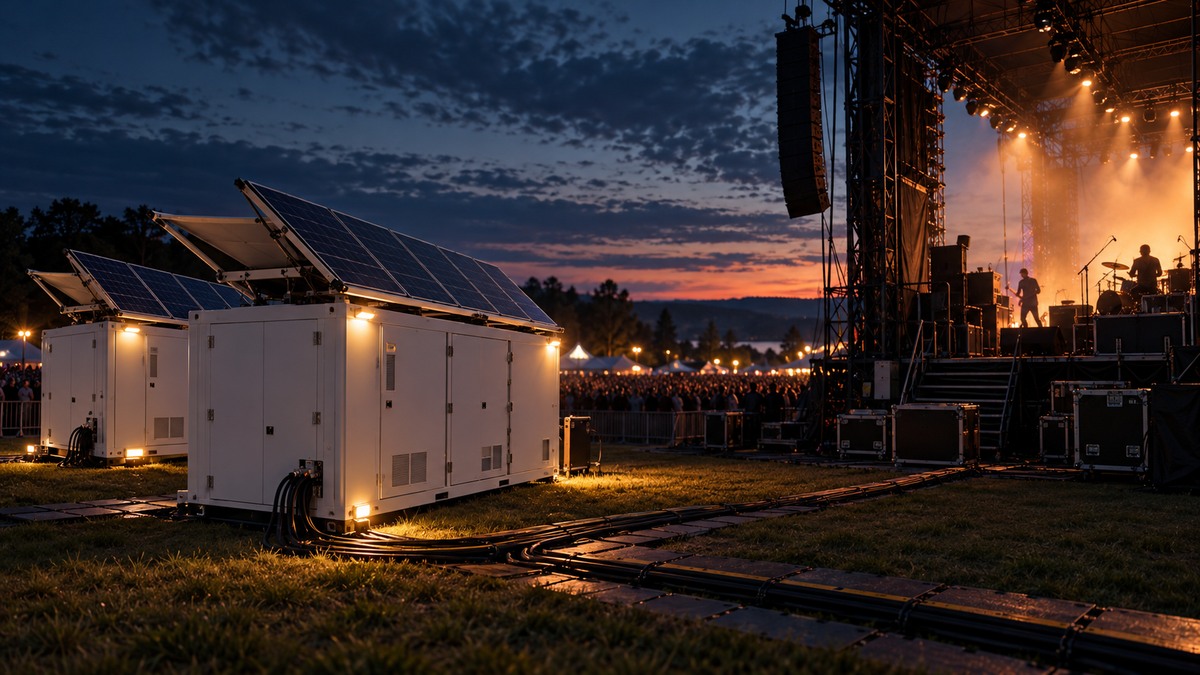
For the distributed systems we deploy — containerized nodes pairing a 140 kWp fold-out solar array with LFP storage from 250 kWh upward — the falling curve shows up as shorter paybacks. Our platform documentation models payback inside five years for clients in hot climates or diesel-dependent locations, with the system’s 10-to-15-year design life delivering low-marginal-cost energy beyond that. Treat those as modeled illustrations, not quotes — the numbers for a specific site depend on loads, tariffs, sun, and incentives, which is what a scoping study establishes. The same logic applies to any payback figure in this market: the price curve improves the odds; it does not guarantee an outcome.
It also changes what gets built. Cheaper storage favors longer durations, larger solar-to-storage ratios, and configurations — like commercial behind-the-meter storage — that were marginal at 2022 prices and are mainstream at 2025 prices.
The U.S. caveats: tariffs and tax credits
Two policy layers complicate the clean story for American projects. The first is tariffs, discussed above, which currently hold U.S. turnkey prices well above the global average.
The second is the federal tax credit clock. Following the One Big Beautiful Bill Act of July 2025, the 30 percent commercial solar Investment Tax Credit runs on a closing window: the begin-construction deadline of July 4, 2026 has now passed, and projects that did not start physical construction by then generally must be placed in service by December 31, 2027 to preserve the full solar credit. Standalone battery storage has a much longer runway — the 30 percent credit remains available through 2032, with phase-downs beginning in 2034, which makes storage the most favorably treated asset in the current U.S. incentive mix. Tax treatment is fact-specific and the rules have moved repeatedly — confirm your project’s eligibility with qualified tax counsel before building it into a pro forma.
Buy now or wait for cheaper?
A falling price curve tempts every buyer toward waiting. Three things argue against it. First, in the U.S., tariffs — not the global curve — set delivered prices, and waiting does not hedge policy. Second, the storage ITC is at its full rate now; incentive regimes have recently moved in only one direction. Third, every year a diesel-dependent or demand-charge-heavy site waits, it pays the incumbent cost — and the category is not waiting: the containerized solar-plus-storage market is growing at a 23.8 percent compound annual rate, on track to nearly triple by 2030 (MarketsandMarkets, September 2025). The rational move is not timing the bottom; it is running the site-specific numbers against today’s prices.
Frequently asked questions
Does $117/kWh mean my project will cost that?
No. It is a global average for turnkey systems; U.S. delivered prices ran roughly $219–$266/kWh in the same survey once tariffs are included, and site-specific factors move the number further. Use the global figure as a trend line, not a quote.
Are batteries now cheaper than gas plants?
In some markets, for some services, yes: BloombergNEF finds levelized storage costs below $100/MWh in six markets, and Ember prices dispatchable solar-plus-storage around $76/MWh in favorable geographies — below new-build gas in those settings. Market-by-market answers vary.
How fast do storage paybacks run at current prices?
Our platform documentation models payback inside five years for hot-climate and diesel-displacing deployments — as a modeled illustration. Actual payback depends on your loads, tariff, solar resource, and incentives, which a site assessment quantifies.
Is the 30 percent tax credit still available?
For standalone storage, yes — through 2032 under current law. For solar, the begin-construction deadline passed in July 2026 and the placed-in-service window runs through the end of 2027. Confirm current treatment with qualified tax counsel.
Run your numbers on the new curve
The price curve has done its part; the remaining variables are yours — loads, tariffs, site, and timing. Explore commercial battery storage, browse the energy glossary, or contact our team for a site-specific model built on current pricing. Mystic Energy — Boca Raton, FL · +1 (762) 316-5592.