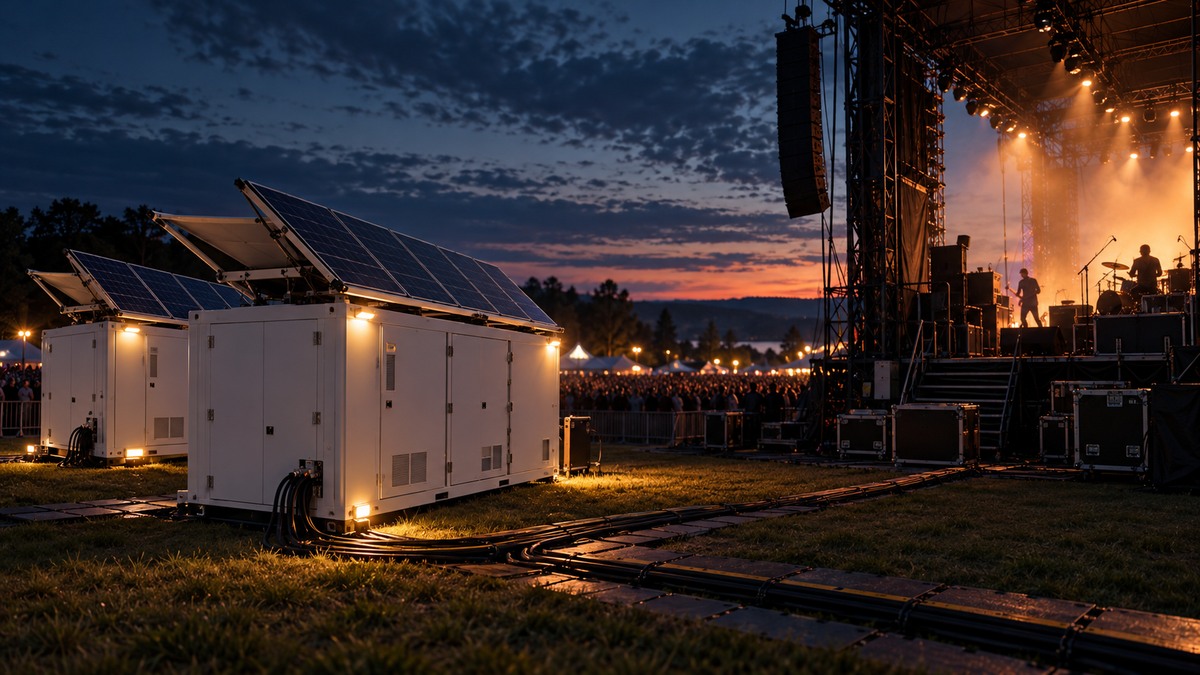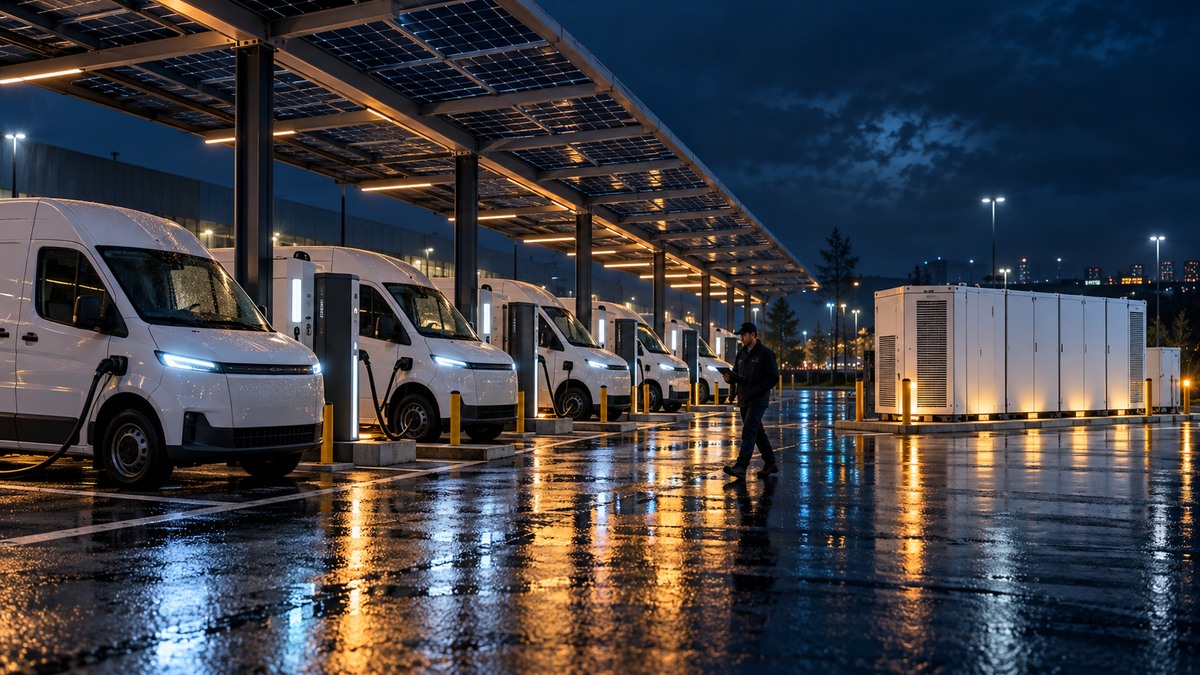
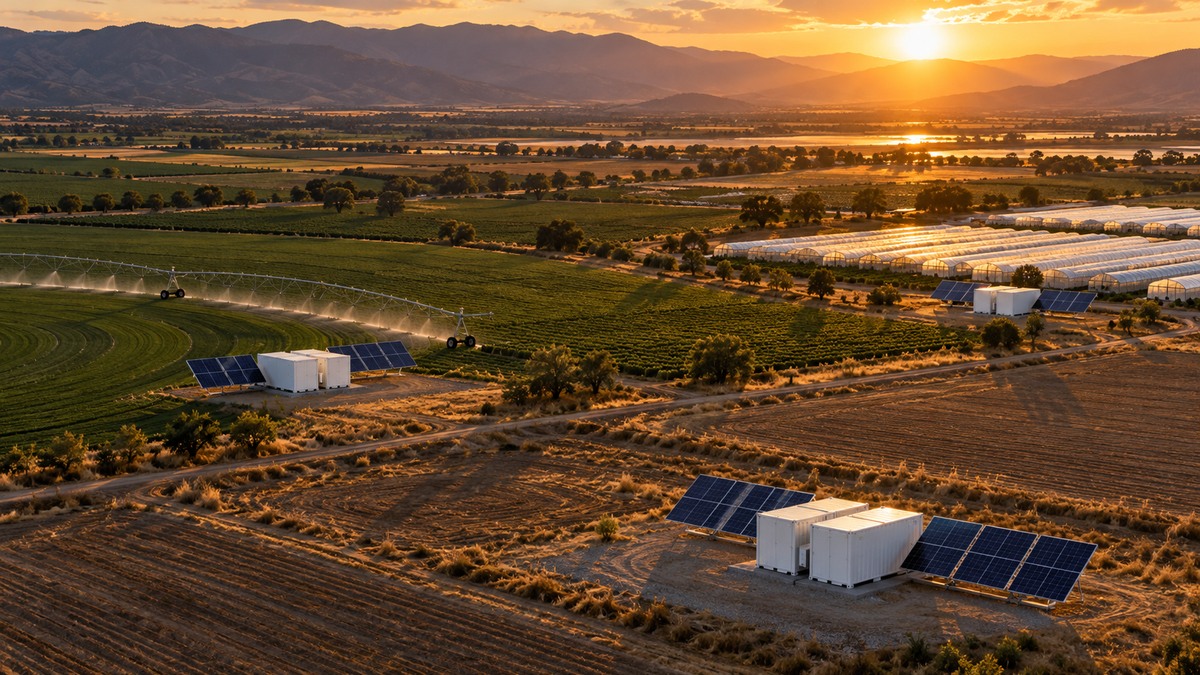
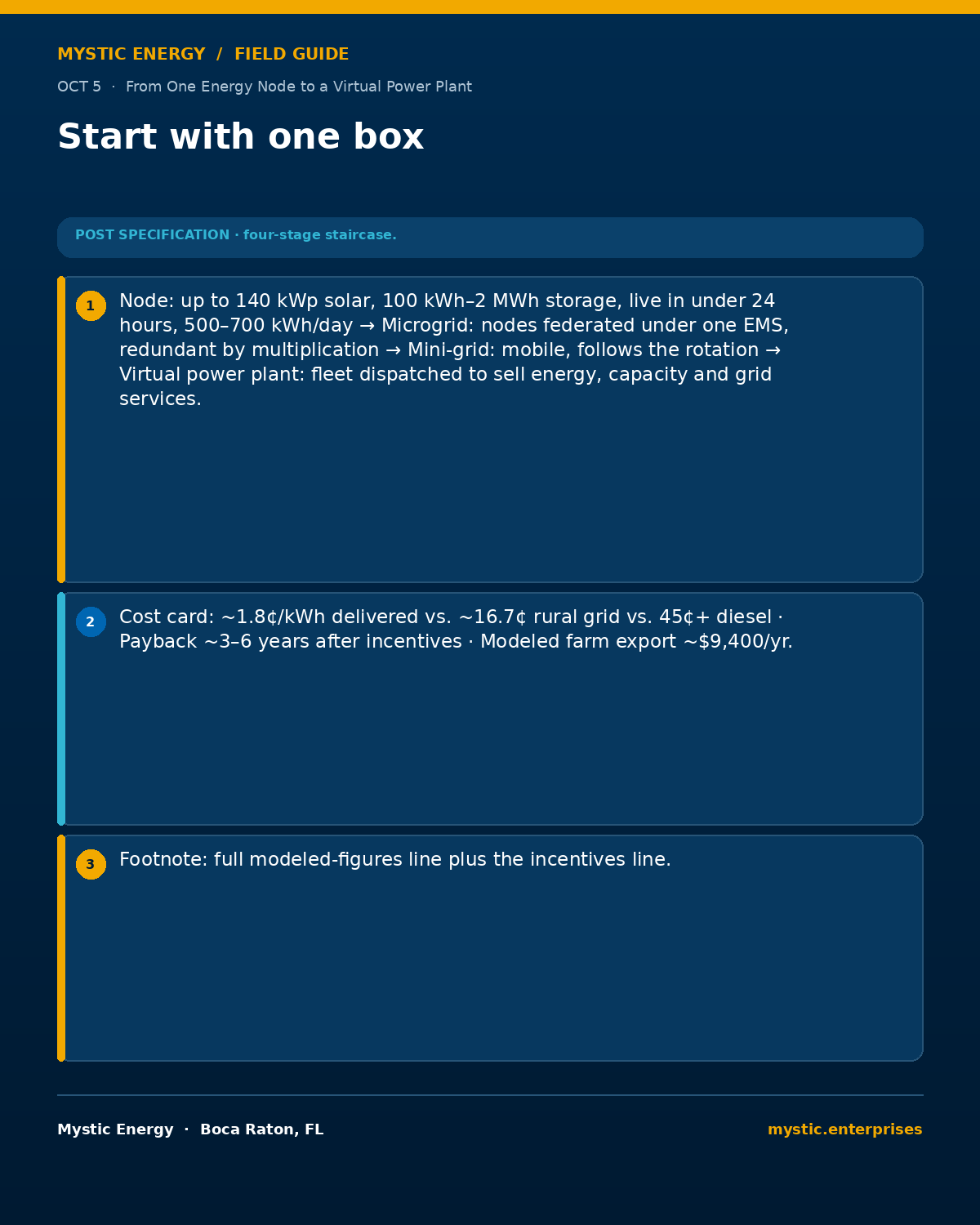
Most energy investments force a sizing decision on day one: build for today’s load and outgrow the system, or build for tomorrow’s and pay for idle capacity in the meantime. Mystic Energy’s deployable platform is designed to dissolve that dilemma. It starts as a single containerized solar-plus-storage node, grows unit by unit into a federated microgrid, scales to a full mini-grid engineered around an entire operation — and, at fleet scale, can be dispatched as a virtual power plant that sells energy and grid services. Here is how that path works, step by step.
Step one: a single node
A node is a complete power plant in shipping-container form. One standard high-cube ISO container houses a fold-out, ground-mounted solar array producing up to roughly 140 kW peak; its companion container integrates lithium iron phosphate (LFP) battery storage with the power conversion, battery management, thermal control, fire suppression, and energy management system (EMS) that make the output firm and continuous. The storage — Mystic Energy’s Energy In A Box — is modular, configurable from 100 kWh to 2 MWh per unit and stackable without practical limit.
Because the system is foundation-optional and factory-wired, it goes from truck to power in under 24 hours on reasonably level ground. In good sun, a base-configuration node produces on the order of 500–700 kWh per day — a mixed farm load, or the equivalent of 30 to 50 homes, around the clock. Everything is monitored and dispatched remotely through Mystic OS. This is the sensible first purchase: one node aimed at the site’s biggest pain point, which for most agricultural operations means irrigation pumping and the diesel generator it replaces.
Step two: federation into a microgrid
The second node is where the architecture starts paying dividends. Multiple nodes federate under a common EMS into a site-wide microgrid: they share load, coordinate charging and discharging, and back each other up, so no single hardware failure takes the operation dark. Capacity is added by adding containers rather than replacing anything — the system a site starts with is the system it scales, which also protects the original investment against obsolescence.
Federation changes the reliability math as much as the capacity math. A single generator is a single point of failure; a federated cluster is redundant by multiplication. For loads that cannot tolerate interruption — cold storage, greenhouse climate control, livestock ventilation — that redundancy is often worth as much as the energy itself.
Step three: the mini-grid — and the mobility dividend
Keep adding and federating nodes and the result is a full mini-grid engineered around the entire operation: irrigation and pumping, buildings and residences, processing and cold storage, and the growing load of electric vehicles and equipment. Because each node remains transportable, the mini-grid is not frozen in place. A node can follow the irrigation season to the pivots, move to a greenhouse for winter, or sit on fallow ground — where our farm analysis notes it keeps generating (and, where a tariff allows, exporting) while the soil rests, then moves on with the rotation. A fixed installation is a building; a node is a tool that goes where the value is.
Step four: the virtual power plant
The final step extends beyond a single site. A fleet of nodes — across one large operation, or many operations in a region — can be dispatched together through a common control and aggregation layer to behave as a single, larger resource: a virtual power plant that sells energy, capacity, and grid-support services where those markets exist. For the individual owner, that means midday surplus is never stranded; it earns through whichever mechanism the local utility offers, from net metering to export tariffs to demand-response programs. For a region, it means distributed sites can add up to a meaningful source of clean, dispatchable power — without a single acre of new transmission corridor.
What the economics look like — modeled, and labeled as such
Mystic Energy’s farm white paper models the delivered cost of a node deployment at roughly 1.8 cents per kilowatt-hour over a 20-year analysis horizon, against a rural grid average near 16.7 cents and fully loaded diesel that can exceed 45 cents. Those figures are modeled illustrations for a new product, not quotes or guarantees — and the 20-year horizon is a modeling assumption; the design life on structural components is 15 years. The same modeling shows payback of roughly 3–6 years after incentives for representative operations, with a modeled Nebraska irrigated-farm case exporting surplus worth about $9,400 per year under a representative net-metering tariff — again, illustrations, with actual results depending on loads, location, and tariff.
Two structural points hold regardless of the specific numbers. First, scaling improves utilization, so delivered cost tends to fall as nodes are added. Second, export revenue turns spare capacity from a cost into an asset: a site can size for growth knowing headroom earns until the operation grows into it. Incentives — federal expensing, the storage investment tax credit, USDA programs, and state and utility layers — can shorten payback materially, but they are structure-dependent and time-sensitive: confirm every incentive and tax figure with qualified tax counsel before relying on it.
Frequently asked questions
Do I have to commit to a mini-grid up front?
No — the opposite is the point. Start with one node against your largest load, prove the economics on your own site, and federate additional nodes as need and confidence grow. Nothing is discarded along the way.
What ties the nodes together?
The energy management system. Each node’s EMS handles its own dispatch — serve load first, charge the battery, then export — and a common control layer coordinates federated nodes as one system, with remote monitoring through Mystic OS.
Is a virtual power plant realistic for a single farm or business?
A single site participates through whatever export or demand-response mechanism its utility offers; the full virtual-power-plant model applies at fleet scale, where aggregated nodes can bid capacity and grid services in markets that support them. Availability depends entirely on the local utility and market design.
What happens if one node fails?
In a federated deployment, the remaining nodes share the load — redundancy by multiplication is a core design feature. Remote monitoring flags issues early, and LFP chemistry is chosen for durability and low maintenance.
Start with one box
Every mini-grid in this architecture began as a single container on a flatbed. Explore commercial battery storage and the Mystic Energy platform, brush up on terms in the energy glossary, or contact our team for a site-specific assessment. Mystic Energy — Boca Raton, FL · +1 (762) 316-5592.