“Microgrid” has become one of those words that gets attached to everything from a rooftop solar array to a backup generator. It deserves better, because the real thing solves a problem the ordinary grid increasingly can’t: keeping a defined set of loads powered, on schedule and through failures, without waiting years for utility infrastructure. Here is what a microgrid actually is, and how one scales from a single building to a campus.
What makes a microgrid a microgrid
A microgrid is a local energy system with two defining properties: a defined electrical boundary — a building, a farm, a campus, a community — and the ability to operate independently of the main grid, a capability engineers call islanding. A generator in a shed is backup; a solar array alone is generation. A microgrid is the orchestrated combination of generation, storage, and controls that can carry its boundary’s loads by itself, indefinitely, and reconnect to the wider grid when it chooses.
The building block: a deployable node
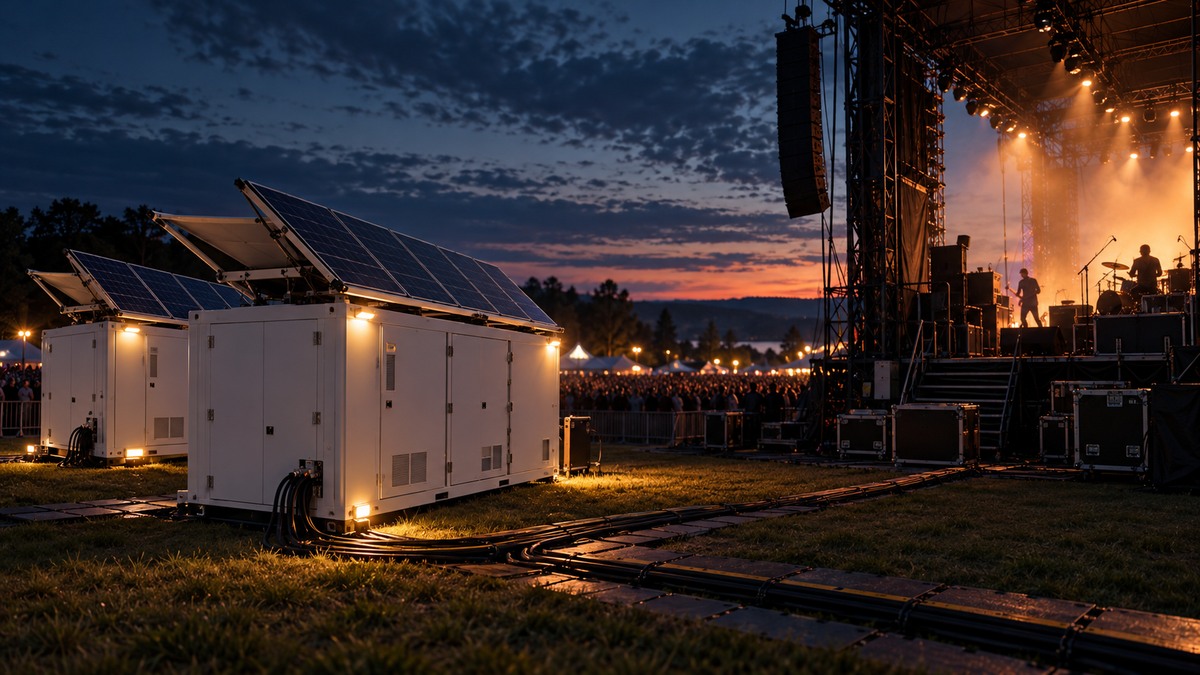
Traditional microgrids are construction projects. Mystic Energy builds them from products instead. The unit is the Deployable Hybrid Power Node: two standard shipping containers, one of which unfolds into a ground-mounted solar array of up to 140 kilowatts peak in under five hours, while the other houses containerized lithium iron phosphate (LFP) battery storage — configurable from 100 kilowatt-hours to 2 megawatt-hours per unit — along with power conversion, battery management, thermal control, fire suppression, and the energy management system (EMS) that runs the whole node. From truck arrival to live power is under 24 hours, with no foundations and no interconnection wait.
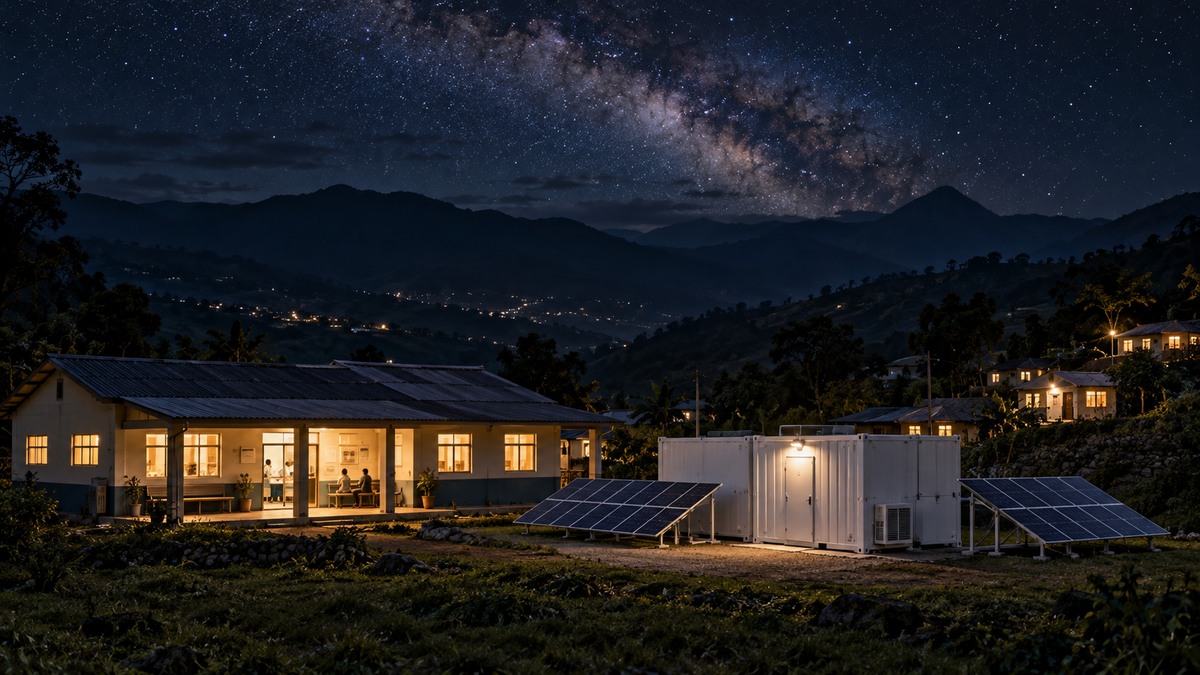
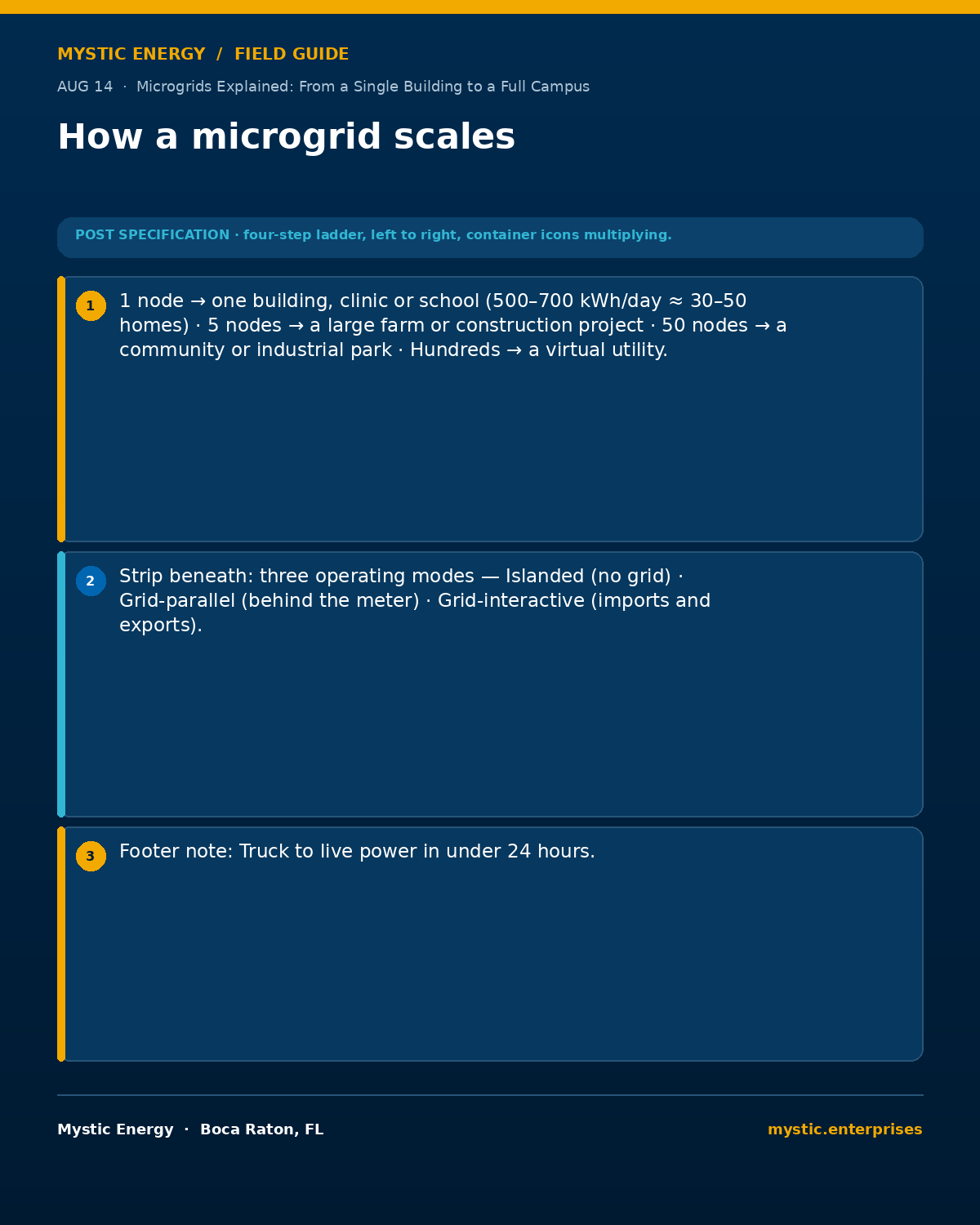
On a good sun day a single node produces roughly 500 to 700 kilowatt-hours — enough to carry the equivalent of thirty to fifty homes, or a clinic, school, or field camp, around the clock with storage headroom to spare.
Three ways to run it
Every node — and every microgrid built from nodes — operates in one of three modes. Islanded, it stands alone, serving an isolated load with no grid at all: remote industry, disaster response, off-grid communities. Grid-parallel, it connects behind the meter, cutting peak-demand charges, arbitraging time-of-use rates, and carrying the site through outages. Grid-interactive, it imports and exports at the meter, selling energy, capacity, and grid-support services. The same hardware moves between modes as circumstances change — which is the point.
From one building to a campus
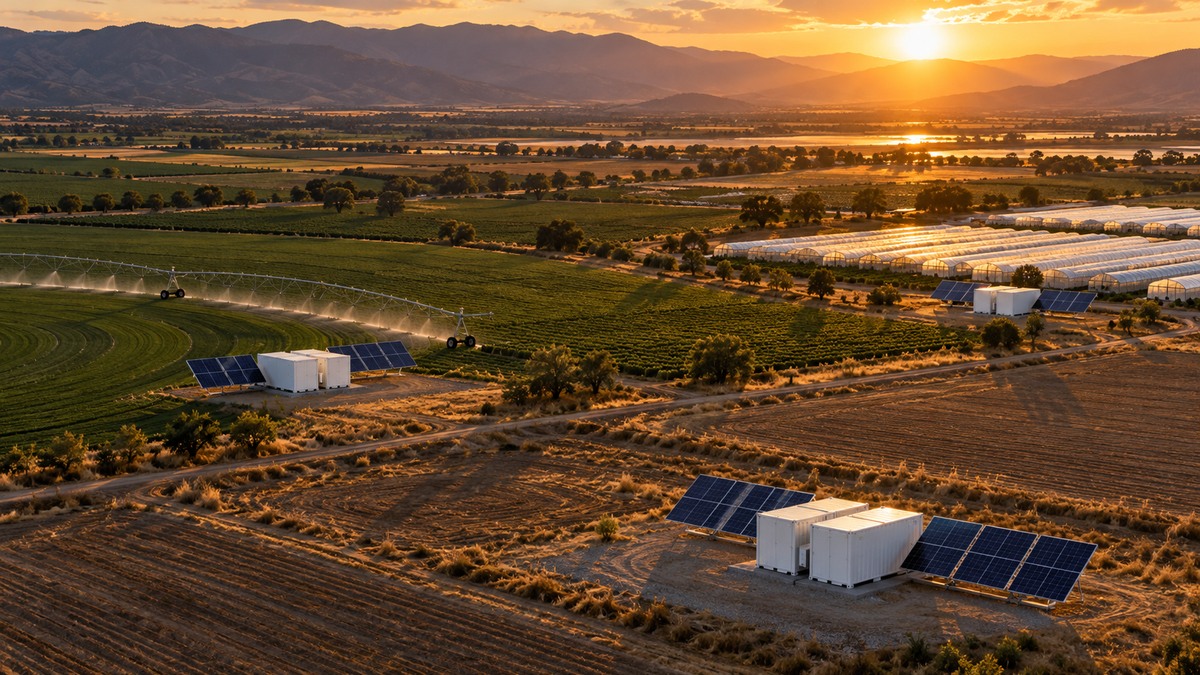
The scaling logic is federation, not redesign. One node powers a building, a clinic, or a large home cluster. Five nodes, federated under a common EMS, run a large agricultural operation or a construction project as a single coordinated system. Fifty nodes become a distributed microgrid for a remote community or an industrial park. And hundreds of nodes, dispatched through a shared aggregation layer, behave as a virtual utility — underwriting the same commercial products as a large solar-plus-storage farm, but with the resilience of a distributed fleet. Redundancy comes by multiplication: in a federated system, no single failure takes the campus dark.
Why microgrids, and why now
The strongest argument is time. Utility-scale energy projects typically take two to five years from land control to operation, gated by interconnection queues, permitting, and construction; a node fleet can be serving load within weeks of a purchase order and redeployed when circumstances change. The second argument is resilience, and it no longer rests on theory. Tyndall Air Force Base in Florida, rebuilt after Hurricane Michael, incorporated solar-paired battery microgrids as a deliberate resilience choice. And at utility scale, Florida’s Manatee Energy Storage Center — 409 megawatts and 900 megawatt-hours of containerized batteries paired with an adjacent solar center — proved the engineering template a decade of grid planners now follow. It is the same template Mystic Energy delivers at distributed, deployable scale: containerized LFP storage co-located with solar.
The economics, honestly labeled
For sites currently powered by diesel, the case is arithmetic. Fully loaded diesel generation at remote sites typically runs $0.35 to $0.80 per kilowatt-hour once fuel, trucking, maintenance, and downtime are counted. In our modeling of hybrid solar-diesel-storage microgrids for remote operations — where existing generators are retained for deep backup but cycled far less — fuel savings of 40 to 70 percent are typical, with the platform paying back in roughly two to four years. These are modeled illustrations, not quotes or guarantees; actual results depend on your loads, sun resource, fuel logistics, and tariffs, which is what a site-specific assessment establishes. The underlying hardware market keeps helping: global turnkey battery-system prices fell to roughly $117 per kilowatt-hour in 2025, the lowest on record.
Frequently asked questions
Does a microgrid mean disconnecting from the utility?
No. Most microgrids run grid-parallel most of the time, using the utility as one resource among several — and islanding only when the grid fails or when prices make independence the better trade. Full off-grid operation is a configuration choice, not a requirement.
How big a load can one node carry?
A single node’s daily production of roughly 500–700 kWh carries the equivalent of thirty to fifty homes, or a mixed commercial or agricultural load, around the clock. Larger boundaries federate multiple nodes; storage per node is configurable from 100 kWh to 2 MWh, so sizing follows the load, not the other way around.
Do microgrids still need diesel generators?
Not necessarily — but keeping existing generators as deep backup is often the strongest configuration. In hybrid designs the generators run a fraction as often, the fuel bill falls accordingly, and the site keeps its insurance policy.
How long does deployment actually take?
A single node goes from truck to live power in under 24 hours on reasonably level ground. Multi-node campuses are typically a matter of weeks — against the two-to-five-year timeline of conventional utility-scale construction.
Draw the boundary, then power it
If there is a building, farm, campus, or community you need to keep powered on your own terms, the microgrid conversation starts with its loads. See the platform behind it on the commercial battery storage page, explore the full renewable energy portfolio, or request a site-specific assessment and we’ll scope a node-based design for your boundary. Mystic Energy — Boca Raton, FL · +1 (762) 316-5592.