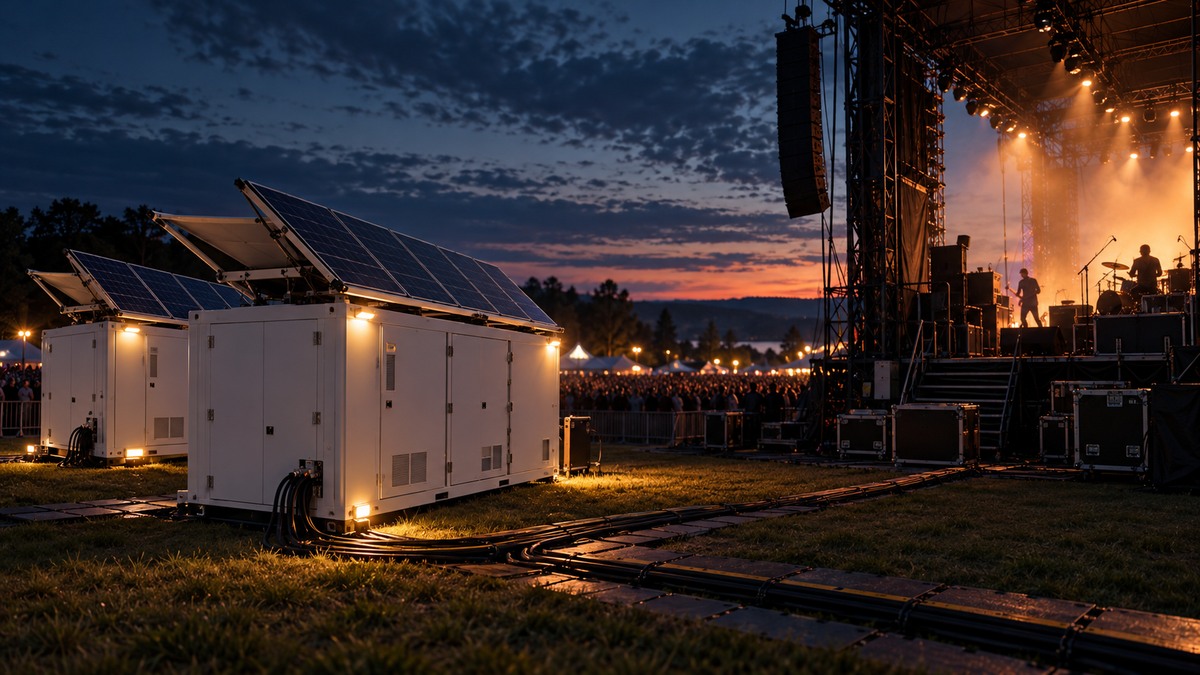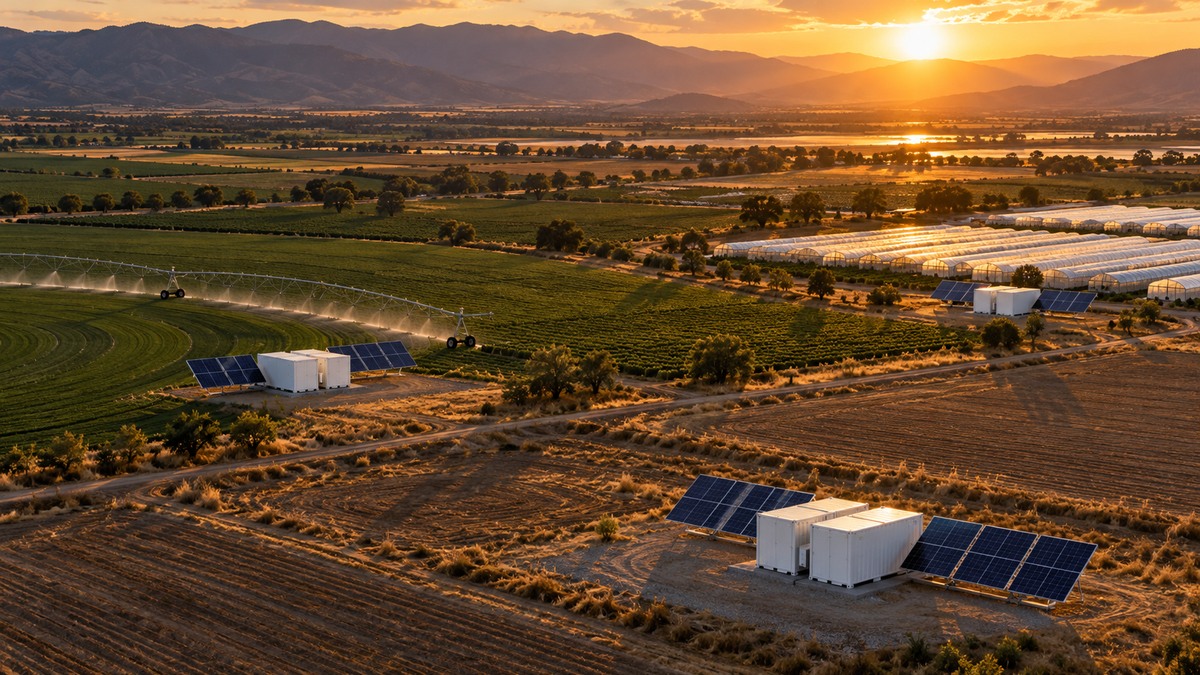
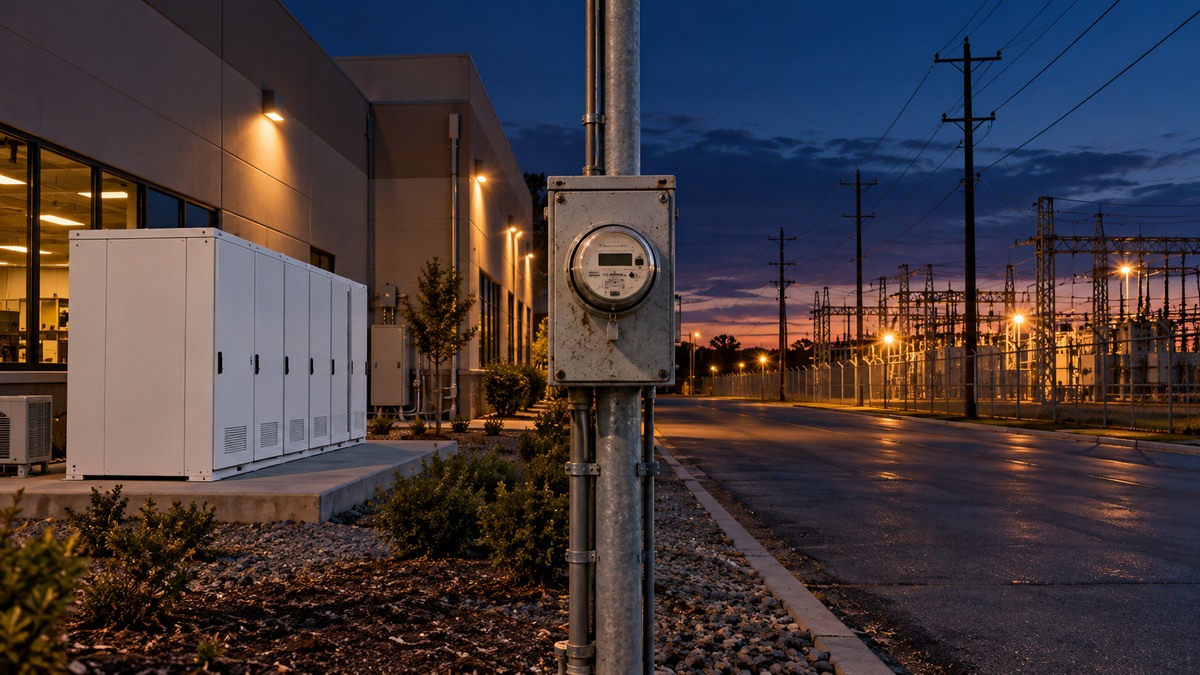
Two identical battery containers can sit on two sites a mile apart and run two completely different businesses. One shaves its owner’s demand charges and rides through outages. The other sells capacity and frequency response into the wholesale market. The hardware is the same. What differs is one design decision: which side of the utility meter the system connects on.
“Behind-the-meter” and “front-of-the-meter” sound like jargon, but the distinction drives everything that matters about a commercial storage project — who the customer is, how revenue is earned, which rules apply, and how long the project takes to energize. Here is the plain-English version.
The meter is a boundary line
Every grid-connected site has a utility meter, and that meter is a legal and commercial boundary. Everything on the customer’s side of it — the building, the loads, the rooftop solar, the battery in the parking lot — is behind the meter (BTM). Equipment connected on the utility’s side, feeding the grid directly rather than a particular building, is front of the meter (FTM).
The physics of the battery does not change across that line. The business does. A behind-the-meter system’s “customer” is the host facility, and its value is measured against the retail electricity bill. A front-of-the-meter system’s customer is the grid itself — a utility, a wholesale market, or an aggregator — and its value is measured against wholesale prices and grid-service payments.
Behind the meter: your side of the boundary
A BTM battery connects inside a facility’s electrical system and works against the retail bill, which for commercial customers usually has two parts: energy charges (the kilowatt-hours consumed) and demand charges (the highest rate of draw in the billing period). Storage attacks both.
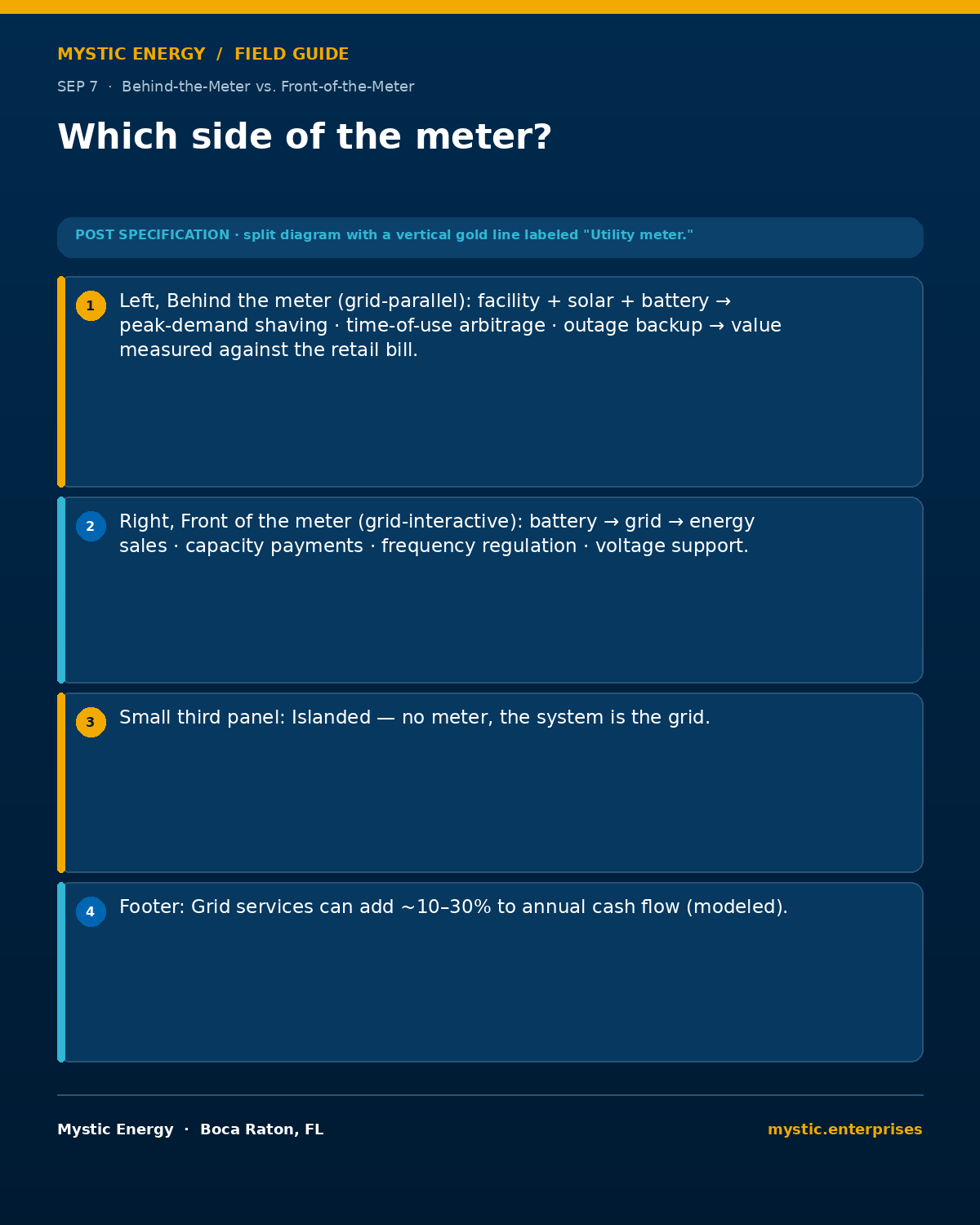
In this configuration — what our platform documentation calls grid-parallel mode — the system typically does three jobs at once. It shaves peak demand, discharging during the facility’s highest-draw intervals so the metered peak, and the demand charge keyed to it, comes down. It arbitrages time-of-use rates, charging when retail energy is cheap (or from on-site solar) and discharging when it is expensive. And it provides backup: when the grid fails, the system islands and carries critical load, fuel-free.
BTM projects are typically faster to build than their grid-side cousins, because they interconnect under distribution-level rules rather than joining a wholesale interconnection queue. For a containerized system like the Mystic Energy node — a 140 kWp fold-out solar array paired with LFP storage from 250 kWh — a commercial behind-the-meter deployment can be serving load within weeks of a purchase order.
Front of the meter: the grid side
An FTM system connects at or beyond the meter — in our documentation, grid-interactive mode — and can import or export freely. It earns from the services the grid will pay for: energy sold into wholesale markets or under contract, capacity payments for being available when the system peaks, and ancillary services such as frequency regulation and voltage support. Modern LFP systems respond in under 50 milliseconds, fast enough to substitute for the rotating inertia the grid is losing as older plants retire.
This is the configuration utilities and independent power producers use at scale. The reference point in our home state is Florida Power & Light’s Manatee Energy Storage Center — a 409 MW / 900 MWh facility built from 132 battery containers paired with an adjacent solar center. Its template, containerized LFP storage co-located with solar, is the same one Mystic Energy delivers at distributed scale as part of the broader Mystic Energy platform.
The trade-off is process. FTM projects face wholesale interconnection studies, market registration, and utility agreements — the single largest schedule risk in grid-side deployments, and a key reason deployable assets that can earn revenue behind the meter first, then re-register, are attractive.
The third option: no meter at all
The distinction assumes a grid worth connecting to. A large share of the deployments we serve — remote agriculture, island communities, disaster response, off-grid resorts — run in islanded mode: the solar-plus-storage system is not behind or in front of a meter, it is the grid, forming voltage and frequency for an isolated load. One node powers the equivalent of thirty to fifty homes around the clock; federated nodes become a microgrid. The energy glossary covers islanding, microgrids, and the rest of the vocabulary.
Why the connection point decides the business model
Where the system connects determines how many revenue streams it can stack. A BTM system’s base value is avoided retail cost — demand-charge reduction plus energy arbitrage plus backup value. In many markets it can layer on demand-response payments without changing its connection. An FTM system trades retail savings for market breadth: energy, capacity, and ancillary services stacked together. Across configurations, our platform documentation models grid-service revenue adding roughly 10 to 30 percent to annual cash flow depending on market design — treat that range as a modeled illustration, not a quote, because market rules vary widely by territory.
The good news: with a modular, containerized platform, this is not a decision that locks you in forever. The same node that starts behind the meter at a distribution warehouse can be redeployed grid-interactive at a substation, or islanded at a disaster staging site. The connection point is a configuration, not an identity.
Frequently asked questions
What does behind-the-meter mean in one sentence?
It means the battery is connected on the customer’s side of the utility meter, so it serves the host facility and earns its value against the retail electricity bill rather than in wholesale markets.
Which configuration pays back faster?
It depends on your tariff and market. Facilities with high demand charges and time-of-use spreads often see the strongest behind-the-meter case; grid-side projects depend on wholesale and ancillary-service prices in their territory. Any payback figure you see in our materials is a modeled illustration — the real answer comes from a site-specific load and tariff analysis.
Can one system do both?
Not simultaneously at most sites — the connection point and the applicable rules differ — but a grid-parallel system can often participate in demand-response programs, and a redeployable containerized system can be moved and re-registered as needs change.
Does off-grid count as behind-the-meter?
No. An islanded system has no utility meter in the picture at all — it forms its own grid, which is its own discipline with its own design requirements.
Work out where your project connects
The right connection point falls out of your tariff, your load profile, and your market — which is exactly what a scoping conversation establishes. Explore commercial battery storage, or contact our team for a site-specific assessment. Mystic Energy — Boca Raton, FL · +1 (762) 316-5592.