For commercial solar and storage projects, the 30 percent federal Investment Tax Credit is usually the single largest line item in the capital stack — and since the One Big Beautiful Bill Act (OBBBA) became law on July 4, 2025, the rules about who still qualifies have tightened dramatically. Most of those rules hinge on four deceptively simple words: when construction began. Get that date, and its documentation, right, and a project locks in the credit. Get it wrong, and the same hardware on the same site can be worth 30 percent less.
Before anything else: this article is general information, not tax advice. “Beginning construction” is a facts-and-circumstances determination that Treasury guidance has reshaped repeatedly — including after OBBBA — and the details vary by technology and project size. Confirm your project’s position with qualified tax counsel before relying on it.
Two ways to “begin construction”
For years, IRS guidance has recognized two routes to establishing that a project has begun construction for credit purposes.
The physical work test
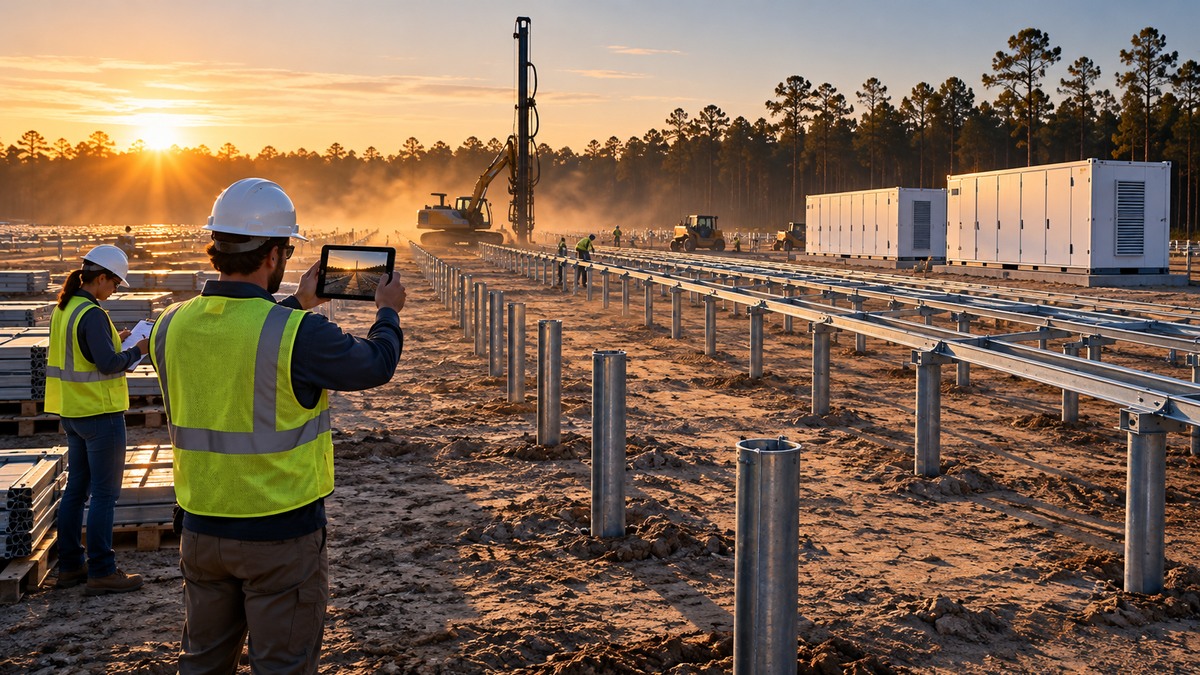
Construction begins when “physical work of a significant nature” starts. That work can happen on-site — foundations, racking, roads built for the project — or off-site, such as a manufacturer starting fabrication of custom equipment for the project under a binding written contract. The test is about the nature of the work, not the dollars spent: preliminary activities like surveying, permitting, and clearing generally do not count, while genuinely project-specific physical work can, even early.
The five percent safe harbor
Alternatively, a project has historically been able to establish beginning of construction by paying or incurring at least five percent of its total cost — typically through equipment purchases — before the relevant deadline. The appeal is certainty: an invoice trail is easier to evidence than a judgment call about “significant” work. The caution is that post-OBBBA Treasury guidance has narrowed which routes remain available for which technologies and project sizes — exactly the kind of moving detail to confirm with counsel rather than a blog post.
Begun is not enough: continuity
Both routes carry a second requirement that trips up more projects than the first: having begun, the project must maintain a continuous program of construction or continuous efforts toward completion. A begin-construction date followed by years of silence invites challenge. In practice that means the paper trail matters as much as the milestone — dated contracts, invoices, delivery records, progress photos, interconnection filings, and board minutes that together tell one uninterrupted story from the qualifying date to commissioning.
Where the deadlines actually stand
As analyzed in Mystic Energy’s hybrid solar-plus-storage white paper, OBBBA left the 30 percent credit in place but put solar on a clock while leaving storage a much longer runway.
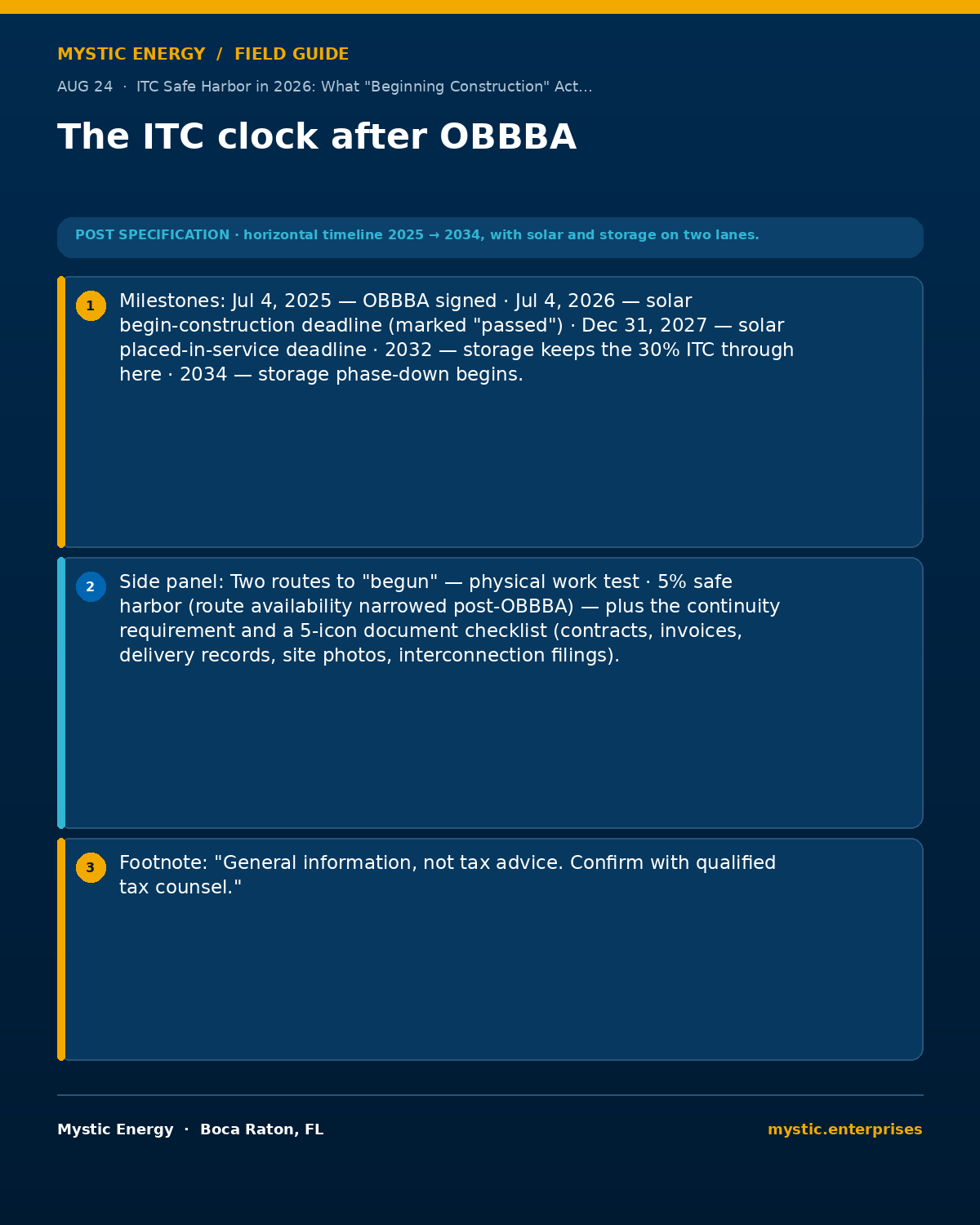
Commercial solar (Section 48E): projects needed to begin physical construction by July 4, 2026 — a deadline that has now passed — or must be placed in service by December 31, 2027, to qualify for the full rate. Projects starting in 2026 and later also face Foreign Entity of Concern (FEOC) rules that add compliance requirements on component sourcing.
Standalone battery storage (Section 48E): materially longer runway — storage projects remain eligible for the 30 percent ITC through 2032, with phase-downs beginning in 2034. For commercial battery storage systems deployed alone or alongside existing solar, this is the most favorable incentive environment in the current U.S. policy mix.
Residential: the Section 25D homeowner credit ended for systems placed in service after December 31, 2025. Residential customers can still access the 30 percent credit through third-party-ownership structures — leases and PPAs — under Section 48E through December 31, 2027.
Domestic content: a further 10 percent bonus remains available for projects meeting domestic content thresholds for steel, iron, and manufactured products.
The August 2026 reality check
With the solar begin-construction date behind us, projects now sit in one of three positions. If you began construction by July 4, 2026, the work now is defensive: assemble and preserve the documentation that proves it, and keep construction demonstrably continuous. If you did not, solar’s remaining path to the full credit is being placed in service by the end of 2027 — a real but compressing window that rewards fast-deploying, factory-built systems over long site builds. And if your economics lean on storage, the pressure drops: the storage credit’s runway through 2032 means a storage-first architecture — or adding storage to existing solar — remains fully creditable on a timeline measured in years, not months. Tax and incentive positions on any of these paths should be confirmed with qualified tax counsel.
Frequently asked questions
What is the ITC safe harbor in plain terms?
It is the set of IRS-recognized ways to lock in a tax credit’s terms by establishing that your project “began construction” before a deadline — historically either starting significant physical work or incurring at least five percent of project cost — plus the obligation to keep the project moving continuously afterward. See the energy glossary for related terms.
My solar project missed the July 4, 2026 date. Is the credit gone?
Not necessarily. Under OBBBA, solar projects can still qualify for the full rate by being placed in service by December 31, 2027. Whether that is achievable is mostly a construction-speed question — and a reason containerized, factory-built systems are attractive right now. Confirm your specific eligibility with tax counsel.
Does battery storage face the same deadline?
No. Standalone storage keeps the 30 percent credit through 2032 with phase-downs from 2034 — the longest runway in the current framework, and a major reason storage-led projects are being prioritized in 2026.
What documentation should a safe-harbored project keep?
Dated binding contracts, invoices and proof of payment, manufacturing and delivery records, site logs and photos, and a record of continuous progress from the qualifying date onward. The credit is claimed on a return but defended with a file.
Build the project, not just the paperwork
The best safe-harbor strategy is a project that moves fast enough to make the question easy. Read our deeper guide to the Investment Tax Credit, see how credits flow through commercial storage economics, or contact our team to scope a deployment timeline that fits the windows that remain — alongside advice from your own qualified tax counsel. Mystic Energy — Boca Raton, FL · +1 (762) 316-5592.