

We have written before about solar-plus-storage against diesel, and about where commercial storage connects to the grid. This post asks a narrower question that comes up in almost every scoping call: take the same project — same site, same solar array — and add batteries. What actually changes? The answer, drawn from our mobile solar-plus-storage white paper, is that storage does not just extend a solar project’s hours. It changes what kind of asset the project is.
What solar-only does well — and where it stops
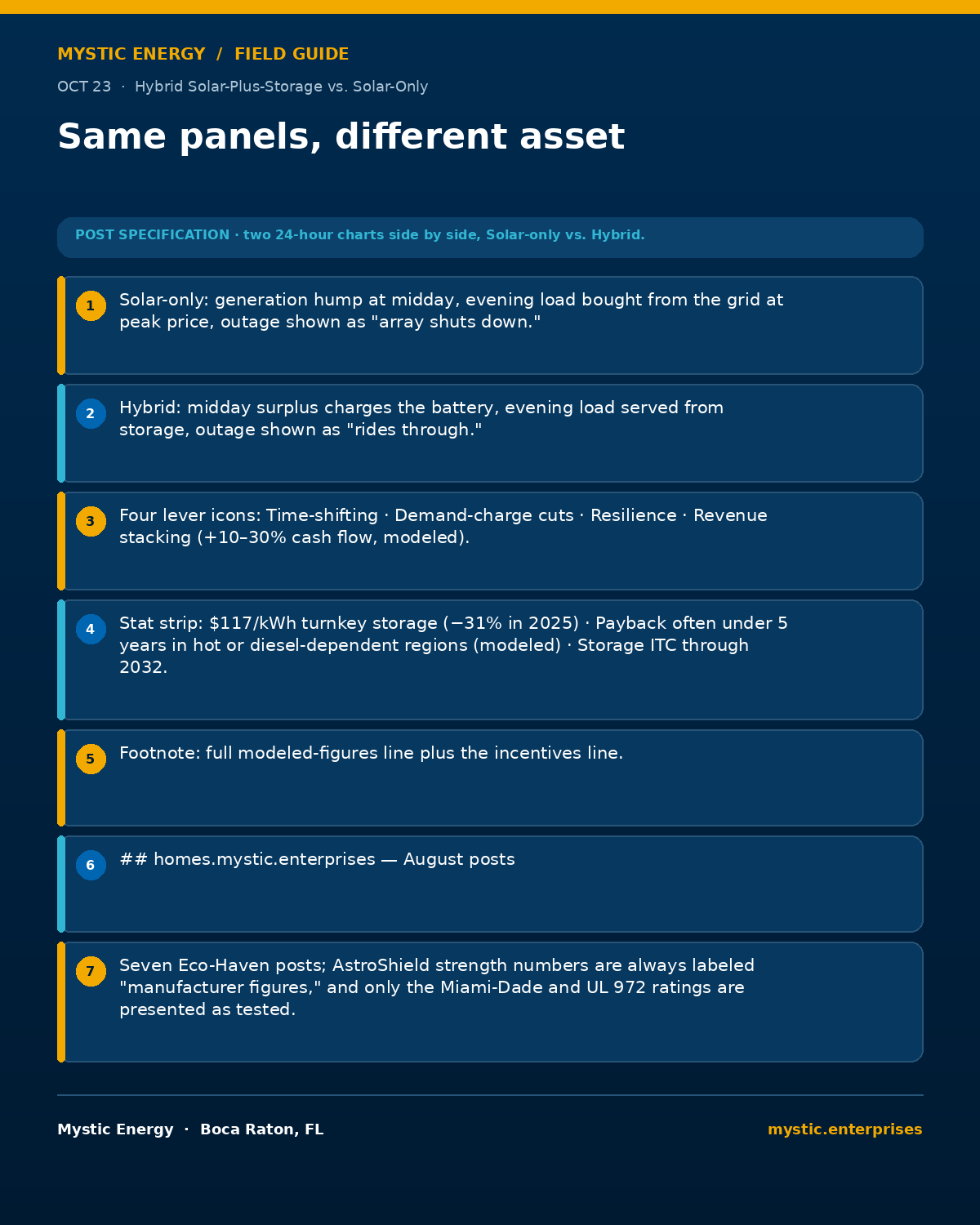
A solar-only project is a fuel-cost hedge. Every kilowatt-hour it produces displaces a kilowatt-hour you would have bought, and at today’s panel prices that trade is excellent — at midday. The limits are structural, not technical. Generation peaks when the sun does, not when your load or your tariff does, so evening peaks still come from the grid at peak prices. Surplus midday energy is exported at whatever rate the utility pays, or curtailed. And a standard grid-tied solar array shuts down in an outage along with the grid it follows — the panels on the roof do nothing for resilience on the day resilience is the point.
The four things batteries add
Pairing storage with the same array adds four distinct economic levers, per our white paper’s client-value framework:
- Time-shifting and arbitrage. Midday surplus is stored and delivered into the evening peak — the energy is consumed or sold when it is most valuable, not when it happens to be produced.
- Demand-charge reduction. For commercial accounts, the battery flattens the consumption spikes that set demand charges — frequently the largest single line on a commercial bill.
- Resilience. A hybrid system rides through outages, carrying critical load from storage and recharging from the array. The white paper’s resilience framing is blunt: fuel-free backup with no supply line to fail.
- Revenue stacking. In many markets, a storage asset can earn beyond energy savings — capacity payments, frequency regulation, voltage support, demand response. Per our white paper, these can add 10 to 30 percent to annual cash flow depending on market design, with the energy management system dispatching across all of them automatically.
The price curve that changed the math
The with-storage case got dramatically stronger in 2025. Per BloombergNEF’s December 2025 cost survey, cited in our white paper, the global average turnkey battery energy storage system price fell to roughly $117 per kilowatt-hour — a 31 percent decline in one year and the lowest level on record, with four-hour systems at about $110/kWh. Ember’s December 2025 analysis puts dispatchable solar-plus-storage around $76 per megawatt-hour — cheaper and faster to build than equivalent new gas capacity — and levelized storage costs are now below $100/MWh in six markets globally. One regional caveat belongs in any honest comparison: US buyers face higher landed costs (roughly $219/kWh pre-tariff and ~$266/kWh with the current tariff regime factored in, per the same survey), which shifts the arithmetic without changing its direction.
Our white paper’s summary of what this means for a deployment pairing a 140 kWp array with 250–500 kWh of LFP storage: clients in hot climates or diesel-dependent regions almost always find payback inside five years. Treat that the way we label all such figures — a modeled illustration from a white-paper analysis, not a quote or a guarantee; your tariff structure, load profile, and incentives decide your number.
The tax asymmetry favors storage right now
US federal incentives currently treat the two halves of a hybrid project differently. The commercial solar ITC’s window is closing — projects needed to begin construction by July 4, 2026, or must be in service by December 31, 2027, to capture the full 30 percent credit — while standalone battery storage remains ITC-eligible through 2032, with a 10 percent domestic-content adder available on qualifying projects. For owners of existing solar, that makes a storage retrofit the most favorably incentivized move in the current policy mix. As always: incentive rules shift and have sourcing conditions attached — confirm current eligibility and timing with qualified tax counsel before building them into a pro forma.
Storage is not all-or-nothing
A detail from our platform design that matters commercially: the solar and storage units are a matched pair, not a locked one. A client can deploy solar now and add storage as load grows, or add storage alone to an existing array — DC- or AC-coupled, with round-trip efficiency in the 85–95 percent range and sub-50-millisecond response when configured for grid support. The with-vs.-without decision is really a now-vs.-when decision, and the staging can follow the budget.
Frequently asked questions
Does adding batteries always improve project economics?
No — and a scoping exercise should say so when it does not. The value of storage concentrates where tariffs have big peak/off-peak spreads, where demand charges are material, where outages are costly, or where the alternative is diesel. A flat-rate, reliable-grid site with modest evening load may be better served by solar alone today and storage later.
Can I add storage to a solar array I already own?
Yes. The storage container deploys alone alongside existing solar, and standalone storage carries the longer federal ITC runway (through 2032 under current law — confirm with tax counsel). This is one of the most common configurations we scope.
How safe are the batteries?
Our platform uses lithium iron phosphate (LFP) chemistry — markedly lower thermal-runaway propagation than NMC chemistries — with cell-level battery management cutoffs, thermal management, and aerosol fire suppression, designed and tested to NFPA 855 and UL 9540A.
What does storage add to project cost?
The honest answer is a range that moves yearly — the BloombergNEF benchmarks above are the public reference points, and 2025 moved them 31 percent in the buyer’s favor. A scoped proposal prices your configuration against the current curve rather than a rate card.
Run both versions of your project
The cheapest time to compare solar-only against hybrid is before either is built. Explore commercial battery storage and the broader Mystic Energy platform, decode the acronyms in our energy glossary, or contact our team to model your site both ways. Mystic Energy — Boca Raton, FL · +1 (762) 316-5592.