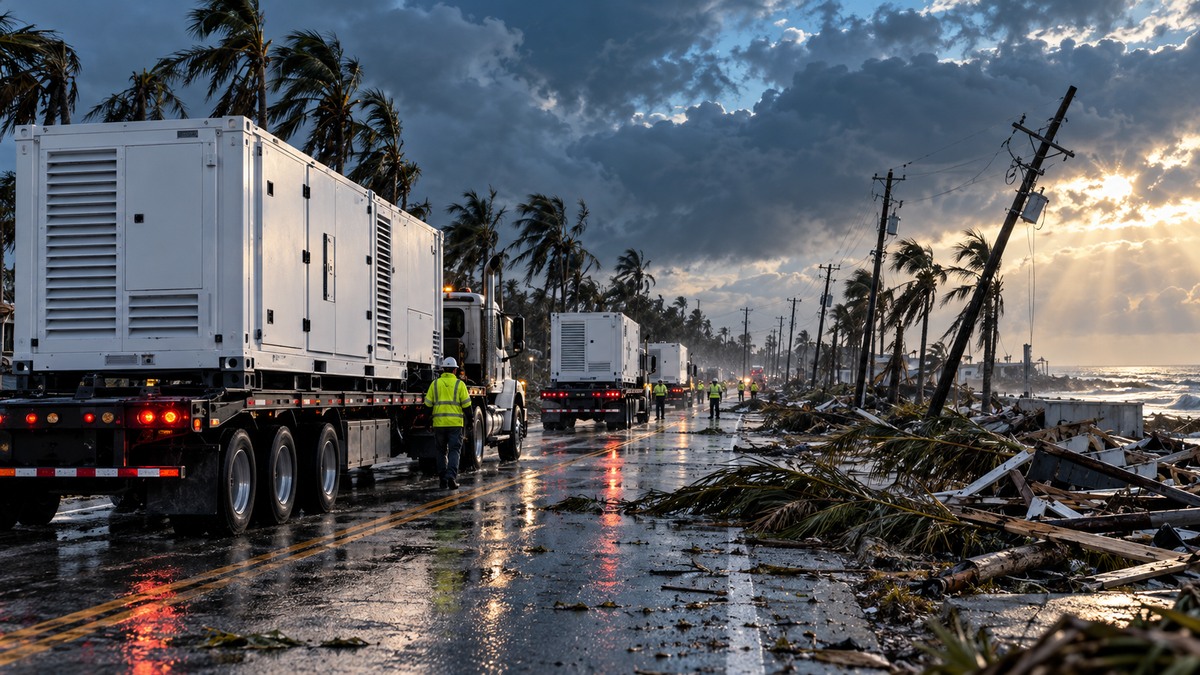
Every emergency manager knows the sequence. The storm passes, the grid is down across three counties, and the facilities that matter most — hospitals, shelters, water treatment plants, communications towers, command centers — are running on diesel generators. Then, within days, the generators meet their real enemy: not the storm, but the fuel logistics behind them. Tankers queue at closed ports, roads are blocked, and the same disaster that took the grid down chokes the supply line that was supposed to replace it. Mystic Energy’s answer to that sequence is not a better generator. It is a different asset class: pre-staged, deployable solar-plus-storage that arrives with the convoy and never needs the fuel truck at all.
The pre-staging model
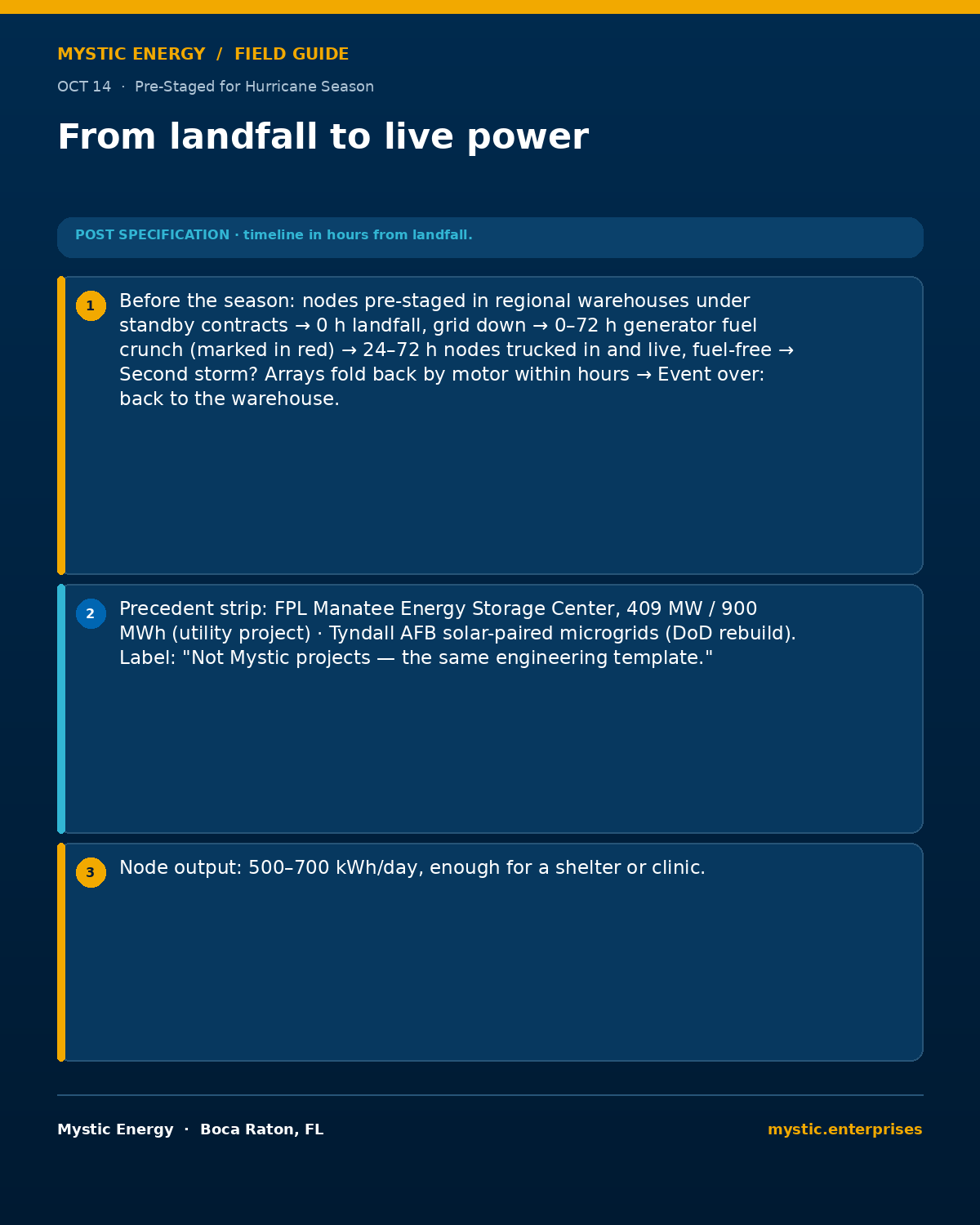
The concept, set out in our hybrid-platform white paper, is straightforward: a fleet of Deployable Hybrid Power Nodes is held in regional warehouses under standby contracts, positioned ahead of the season rather than procured after the event. When a storm makes landfall, nodes are trucked into the affected area and are producing clean, fuel-free power within 24 to 72 hours. Between events, the same nodes return to the warehouse — earning on standby rather than sitting as sunk cost, and available again for the next activation.
That timing matters because it maps onto the window when disaster response actually breaks down. The first three days after landfall are when generator fuel demand peaks and fuel delivery is least reliable. An asset that is self-fueling from the moment the array unfolds removes the single most fragile dependency in the response plan.
What one node delivers
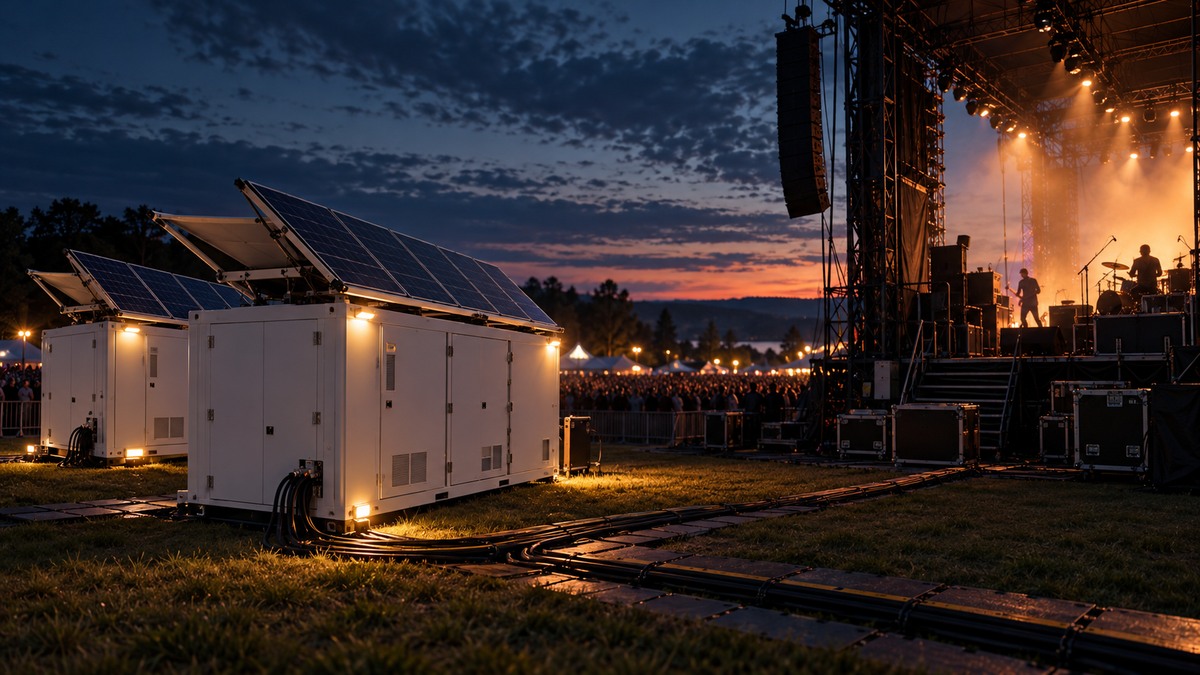
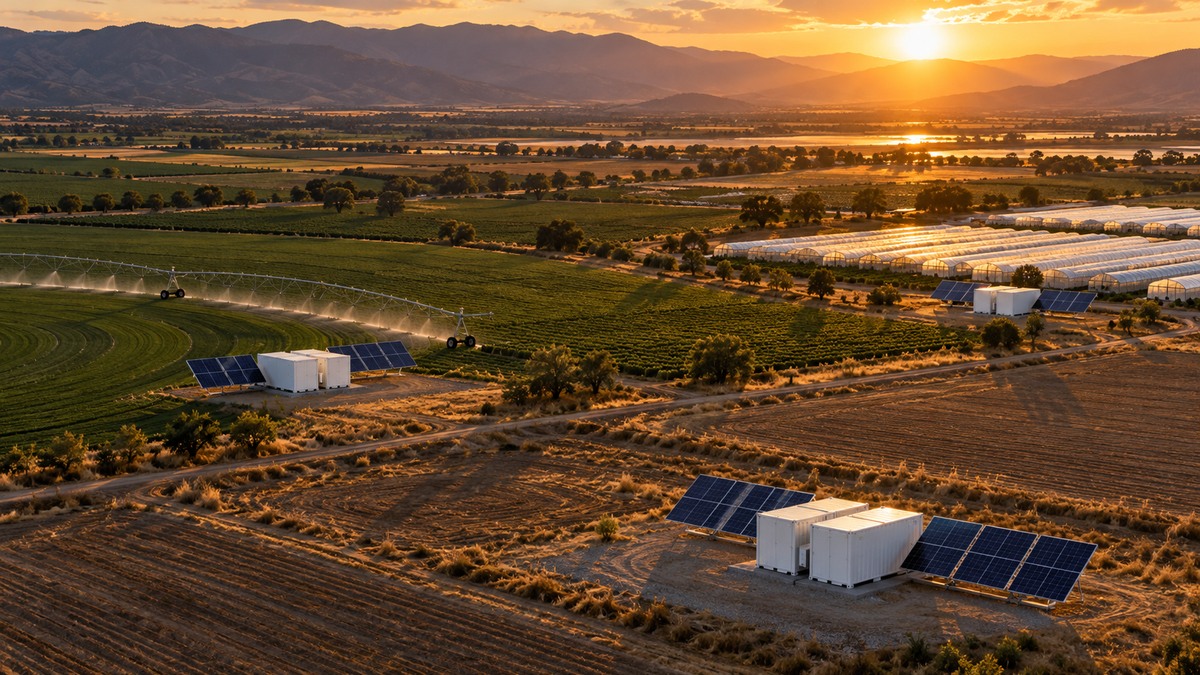
A node is a two-container, crane-transportable power plant. The solar container unfolds in under five hours into a roughly 720-square-meter ground-mounted array producing up to 140 kW peak; the companion container integrates lithium iron phosphate (LFP) battery storage — typically configured from 250 kWh upward — with power conversion, battery management, thermal control, and fire suppression built in. On a typical sunny day in Florida or the Caribbean, one node produces roughly 500 to 700 kilowatt-hours: enough to carry a shelter, a clinic with cold-chain storage, a water-treatment site, or a command post around the clock, with storage bridging the nights.
Nodes also federate. A cluster deployed across a fairground or hospital campus operates as a microgrid, sharing load and backing each other up — redundancy by multiplication, instead of a single generator as a single point of failure.
Built for the weather that creates the mission
A disaster-response power asset has to survive the environment it works in, and the platform is designed around that reality. The array’s defining weather feature is its motorized fold-back mode: if a second storm threatens an active deployment, the wings retract into the container within hours, ride out the weather, and redeploy afterward. Deployed arrays sit low to the ground — a wind profile closer to a fence than a pitched solar farm — and are ballasted or anchored to the site’s design wind speed. The storage container is a sealed, marine-rated enclosure engineered for tropical heat, humidity, and salt. Storm response is a designed-in operating mode, not an improvisation.
The precedent is already built in Florida
None of this rests on an unproven engineering template. Florida’s investor-owned utilities — Florida Power & Light, Duke Energy Florida, Tampa Electric, and Florida Public Utilities — have all invested in solar-paired storage as a resilience asset. The clearest reference point is FPL’s Manatee Energy Storage Center in Parrish, Florida: a utility project pairing 132 battery containers (409 MW / 900 MWh) with an adjacent 74.5 MW solar center, commissioned in 2021. And after Hurricane Michael, the U.S. Air Force’s rebuild of Tyndall Air Force Base made solar-paired battery microgrids a deliberate resilience design choice — a Department of Defense precedent for the same approach. Those are utility and DoD projects, not Mystic deployments — but they validate the template: containerized LFP storage paired with solar, which Mystic Energy delivers at the distributed, truck-mobile scale that fixed utility assets cannot reach.
Who pre-stages, and how
The natural holders of pre-staged fleets are state and municipal emergency management agencies, utilities and their resilience programs, counties with continuity-of-operations plans, and the contractors and NGOs that support them. Commercially, pre-staging typically runs through our deployment-as-a-service structure — a standby plus activation fee that bundles warehousing, delivery, commissioning, operation, and retrieval — or through outright fleet purchase with Mystic Energy retained for operations and maintenance. Engagements are scoped per program; agencies planning for next season should start the conversation well before it.
Frequently asked questions
How fast can power actually be on site after a storm?
The pre-staging model targets 24 to 72 hours from activation to live power, driven mostly by trucking distance from the staging warehouse. The node itself commissions in under 24 hours from arrival, with the solar array unfolding in under five hours.
What happens if another storm hits during a deployment?
The array retracts by motor into its container within hours and redeploys after the weather passes. The storage container is a sealed marine-rated unit, and deployments are ballasted or anchored to the site’s wind regime.
Does this replace diesel generators entirely?
In most response plans it displaces the bulk of generator runtime rather than every generator. Nodes carry critical facilities continuously; retained generators become deep backup, cycled far less and far less exposed to the fuel bottleneck.
What does a standby arrangement cost?
Pre-staging programs are priced per engagement — fleet size, warehouse location, and activation terms drive the figure — so we scope each program rather than publish a rate card. Contact our team to model one for your jurisdiction or facility portfolio.
Position the fleet before the season does
Hurricane season is an annual certainty; fuel logistics failing after landfall is nearly one. The agencies and operators that fare best are the ones whose power assets are positioned before the forecast cone appears. Explore the Mystic Energy platform and commercial battery storage, brush up on the vocabulary in the energy glossary, or contact our team to scope a pre-staging program. Mystic Energy — Boca Raton, FL · +1 (762) 316-5592.