Over the past month on this blog we have walked through the renewable resources that make Central and South America, in our view, the best-positioned region on Earth for a full-spectrum clean energy transition: wave energy along its thousands of kilometers of coastline, and geothermal along the Pacific Ring of Fire. This post completes the picture with the resource that ties the portfolio together: wind. In our “Becoming a Green Energy Superpower by 2035” roadmap, wind is not the headline act — solar and geothermal carry more of the projected mix — but it plays a role neither of them can: balancing solar’s variability across the grid, and sharing offshore infrastructure with wave energy to cut the cost of both.
The resource: two kinds of corridor
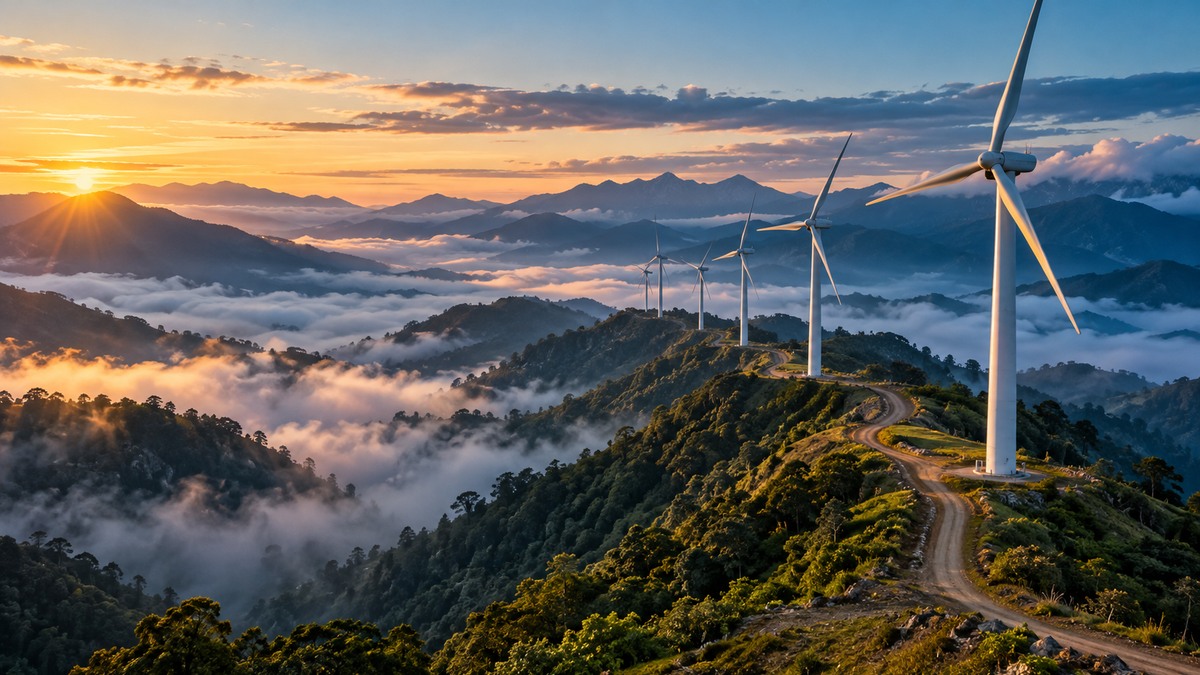
Latin America’s wind resource concentrates in two geographies. Coastal corridors — on both the Pacific and Atlantic sides — benefit from the steady thermal circulation between sea and land, and open the door to offshore development. Highland corridors — ridgelines and high plains funneling wind through mountain terrain — offer strong, exploitable resources inland, often close to population centers that coastal projects cannot reach economically.
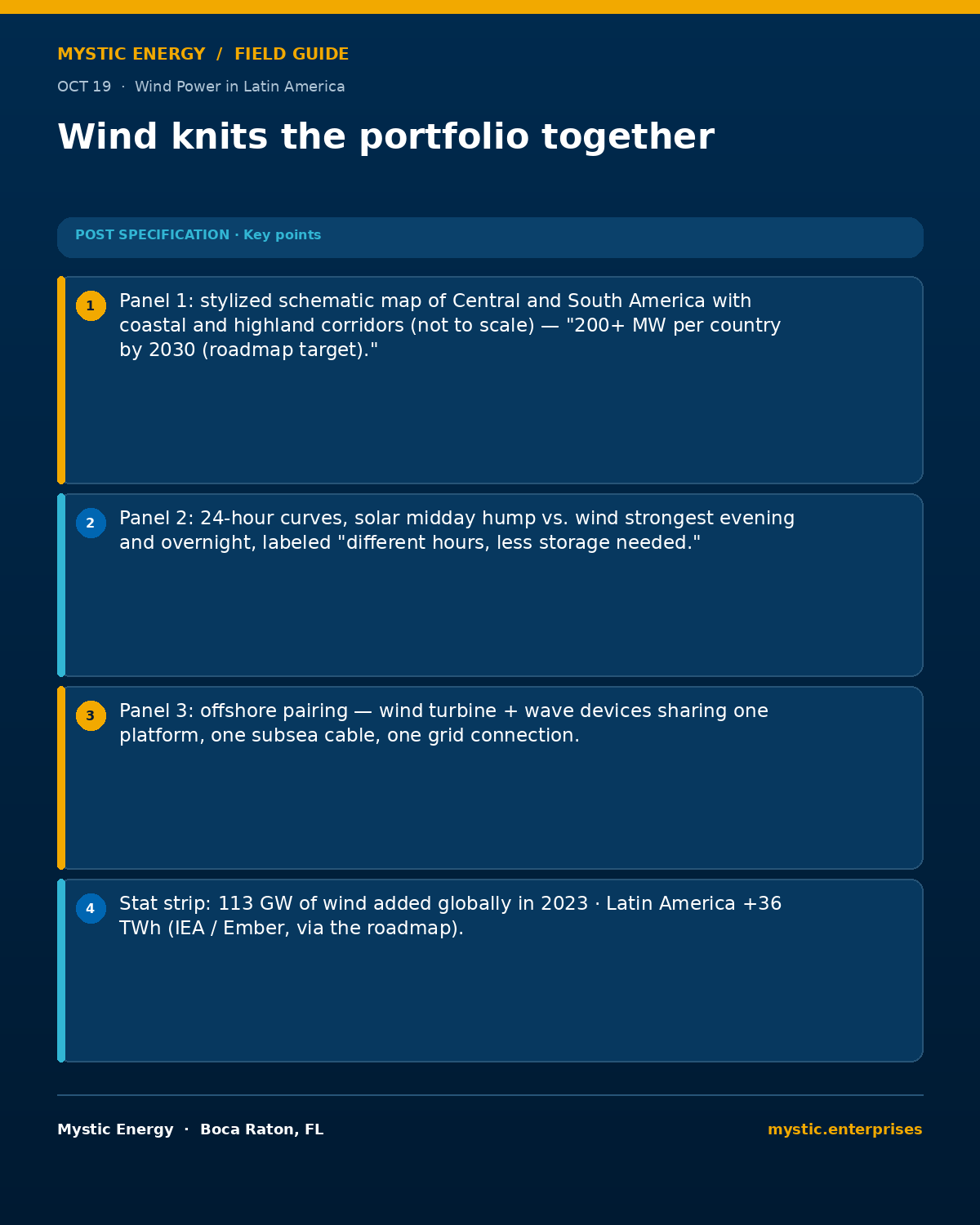
Our roadmap puts a number on the opportunity: the region’s coastal and highland corridors can support 200+ megawatts of wind development per country by 2030, across onshore and offshore projects. That figure — drawn from the roadmap’s source base, which includes IEA and Ember regional reporting — is a development target in a vision document, not a project commitment, but it is deliberately conservative relative to what the geography allows.
The global tailwind
Wind is not a frontier technology that partner nations would be betting on alone. Per the IEA and Ember data cited in our roadmap, the global wind sector added roughly 113 gigawatts of capacity in 2023 alone — and Latin America contributed about 36 terawatt-hours to that growth. The turbines, the supply chains, the construction expertise, and the financing models are mature. What the region adds is a resource quality that lets that mature technology produce more per installed megawatt than it does in most of the markets where it was developed.
Why a solar-heavy grid needs wind
In our 2035 vision mix, solar carries roughly 30 percent of the energy mix and wind roughly 10 percent — vision figures, to be clear, not forecasts. So why bother with the smaller slice? Because the two resources fail and deliver at different times. Solar output follows the sun: strong at midday, gone at night, dented by cloud cover. Wind frequently delivers in the hours and seasons when solar does not — through evenings, overnight, and across weather systems. A grid that pairs them needs less storage and less backup capacity than a grid that leans on either alone. That is the specific role our roadmap assigns wind: balancing solar variability across the grid, so the whole renewable portfolio behaves more like dependable capacity.
The offshore pairing with wave
The most distinctive recommendation in our roadmap is to develop offshore wind together with wave energy farms rather than as standalone projects. The logic is infrastructure sharing. Offshore energy projects spend heavily on things that have nothing to do with the generator itself: marine platforms, subsea transmission lines, shore crossings, and grid connection points. Wave and wind devices can share all of them. Co-locating the two means one transmission corridor, one interconnection, and one marine-operations footprint serving two generation profiles — wave’s steady, predictable output smoothing wind’s variability at the same connection point. Per the roadmap, that shared-infrastructure approach reduces costs significantly for both technologies, and it is why we treat wave and wind as a synergistic pair rather than competing line items.
Where Mystic fits
Mystic Energy’s wind advisory covers lightweight, high-output turbine technology designed for extreme climates — by our design approach, residential-scale applications can work with winds as modest as a steady 5 miles per hour, while utility-scale corridor and offshore projects follow the partnership model our roadmap describes for solar and geothermal: development structured with local hiring and technology-transfer commitments, in coordination with multilateral funders where project scale requires it. Wind is one piece of a portfolio strategy — the roadmap’s recommendation to governments is to approve the fast assets (solar), fund the studies for the marine assets (wave), build the baseload (geothermal), and let wind knit the system together.
Frequently asked questions
Why does wind get a smaller share than solar in the 2035 vision?
Because the region’s solar economics are exceptional — tropical latitudes deliver roughly 30 percent higher solar yield than Europe or the US, per our roadmap — and solar deploys fastest. Wind’s value is complementary: it generates in hours and seasons solar cannot, which makes the whole mix more dependable. The 10 percent figure is a vision allocation, not a ceiling.
Is offshore wind realistic for smaller economies?
On its own, the capital cost is demanding. That is exactly why our roadmap recommends pairing offshore wind with wave energy farms — shared platforms, transmission, and grid connections spread the infrastructure cost across two generating assets. Feasibility work for the two should be commissioned together.
What does “200+ MW per country” actually mean?
It is the development target our roadmap sets for 2030, based on the corridor resources the region’s geography supports and the regional growth reported by the roadmap’s IEA and Ember sources. It is a target in a vision document — actual capacity depends on each nation’s siting, permitting, and procurement decisions.
Can wind work at the scale of a single home or farm?
Mystic’s wind advisory includes lightweight turbine designs intended for residential and small-site use in modest wind regimes — per our materials, as little as a steady 5 mph. Whether wind or solar-plus-storage is the better fit for a specific site depends on the local resource; that is a scoping conversation, not a catalog answer.
Complete the portfolio
A grid built on one renewable is a bet; a grid built on four is a system. Explore the Mystic Energy platform, brush up on the terminology in our energy glossary, or contact our team to talk about wind, wave, geothermal, and solar as one portfolio. Mystic Energy — Boca Raton, FL · +1 (762) 316-5592.