
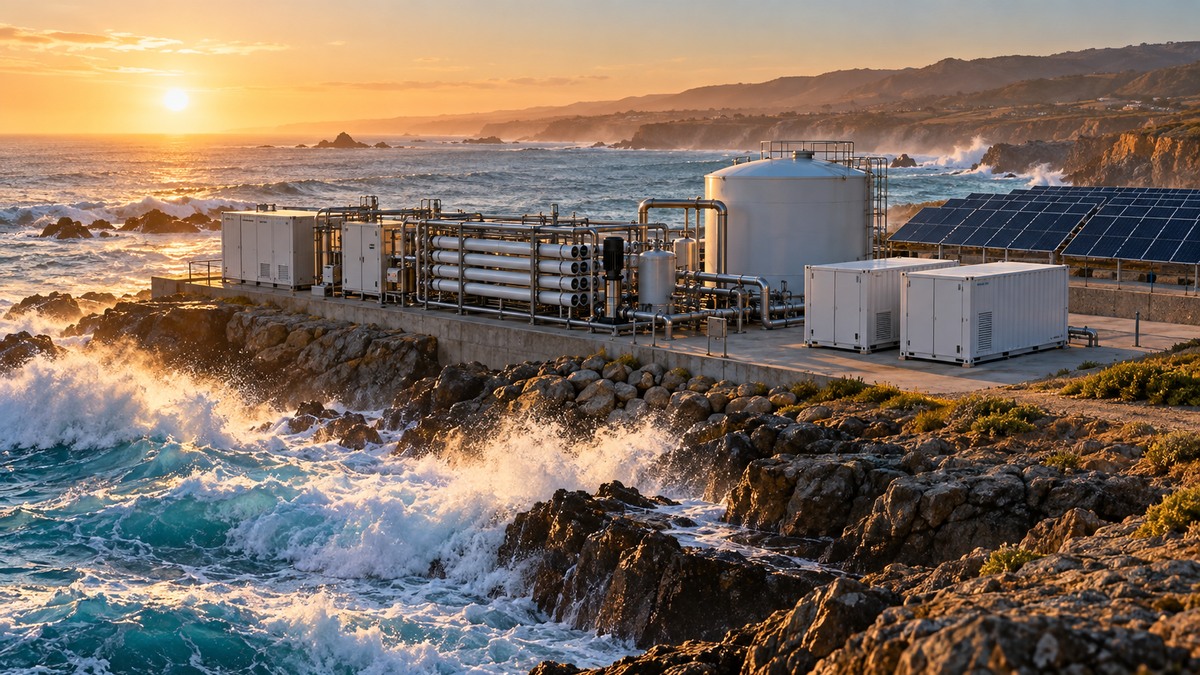
Water scarcity and energy cost look like two separate crises. For any community or operation that depends on desalination, they are the same crisis. The pumps, membranes, and treatment trains that turn seawater or brackish groundwater into drinking water run on electricity — and in most of the world’s water-stressed places, that electricity is expensive, imported, or both. Solve the energy problem and the water problem gets dramatically smaller. That is the logic of pairing desalination with renewables, and it is one of the most practical water-energy plays available today.
Desalination is an energy problem in disguise
Modern seawater desalination is dominated by reverse osmosis: seawater is forced at high pressure through semi-permeable membranes that pass water molecules and reject dissolved salts. High pressure means big pumps, and big pumps mean that electricity is the defining operating cost of making fresh water. The same is true at smaller scale for brackish groundwater treatment and water reuse — the historic barrier has never been the membranes; it has been the power bill to run pumps, filtration, and treatment. On grid power, that bill can be large enough to make on-site water treatment uneconomic. When the electricity comes from on-site renewables at near-zero marginal cost, the calculation inverts.
What renewable power changes
Pairing a desalination or purification plant with solar generation and battery storage does three things at once. First, it attacks the dominant cost line: midday solar runs the plant at near-zero marginal energy cost, and storage extends operation into the evening. Second, it decouples water production from grid reliability — on island and coastal grids that run on imported diesel and carry some of the world’s highest electricity prices, that means water keeps flowing through outages and fuel-price spikes alike. Third, storage turns the plant into a flexible load: production can lean into the cheapest, sunniest hours, with the battery smoothing the gaps.
This is the same containerized solar-plus-storage architecture Mystic Energy deploys for farms, commercial sites, and microgrids — applied to the water sector, where the load profile of pumps and treatment equipment is steady, predictable, and ideally suited to solar-plus-storage operation. In our platform modeling, on-site solar-plus-storage delivers energy at a small fraction of typical island grid or diesel-generation cost; those figures are modeled illustrations rather than quotes, and a site-specific assessment replaces the model’s assumptions with your actual loads and tariffs.
The brine bonus: when the waste stream makes power
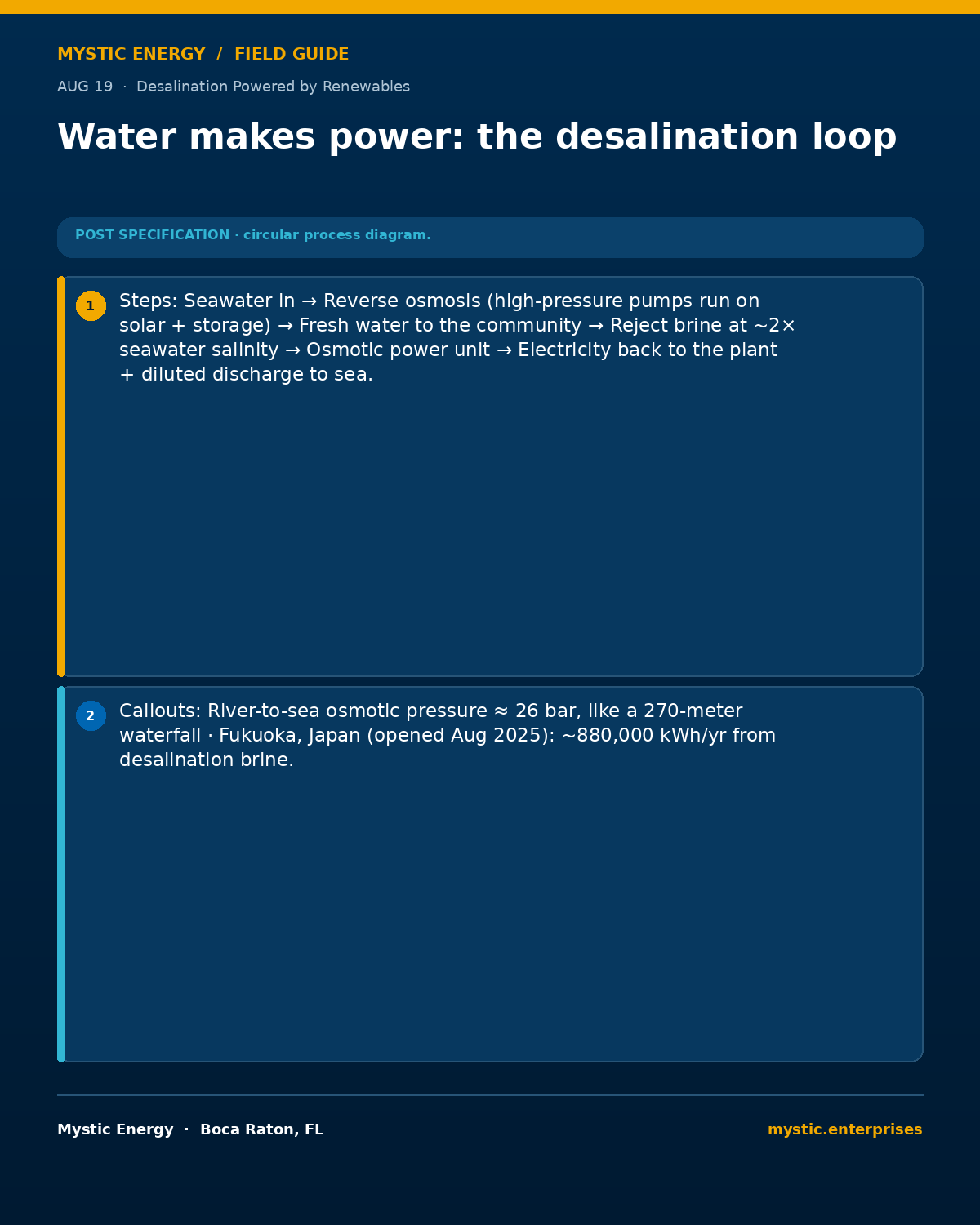
Here is where the water-energy pairing gets genuinely elegant. Every seawater reverse-osmosis plant produces a concentrated reject brine at roughly twice the salinity of seawater — a stream most plants pay to dispose of through offshore diffusers. Osmotic power turns that liability into a generator. Place a salinity gradient across engineered membranes and the mixing energy of salt and fresh water becomes extractable electricity: the pressure differential between typical river water and seawater is about 26 bar, thermodynamically equivalent to a 270-meter waterfall, and desalination brine at double seawater salinity delivers an even steeper gradient.
This is no longer theory. The world’s largest operational osmotic power plant, opened in Fukuoka, Japan in August 2025, is co-located with a seawater desalination plant and runs on its reject brine, producing roughly 880,000 kWh per year — enough to power the desalination plant’s own auxiliary loads plus about 220 homes — while diluting the discharged brine back toward seawater salinity. Two disposal costs become one integrated asset: the plant makes water, its waste stream makes power, and the environmental footprint of the discharge shrinks. Mystic Energy’s white paper on osmotic power examines this co-generation model in depth as one of the most economically attractive configurations in the sector today.
Bundled water-plus-power for islands and coasts
For the Caribbean, Costa Rica, and coastal jurisdictions across Latin America — and increasingly for Florida communities weighing both water supply and grid resilience — the natural project shape is bundled infrastructure: a single development that builds water production and renewable generation together, sells potable water to a municipal or tourism offtaker, and delivers surplus power locally. Water security and energy security stop being separate procurements and become one resilient asset. That vertically integrated model is where Mystic Energy focuses its advisory and development work: renewable generation, storage, and water treatment engineered as one system rather than bolted together after the fact.
Frequently asked questions
Why is desalination so energy-intensive?
Reverse osmosis works by pushing seawater through membranes at high pressure, and generating that pressure with pumps is electricity-hungry. Energy is the defining operating cost of a desalination plant, which is why the price of power largely sets the price of the water.
Can solar really run a desalination plant if the sun sets?
That is what battery storage is for. Solar carries the plant through the day while charging the battery; the battery extends operation into the evening, and where a grid or backup generation exists it fills the remaining gap. Plant sizing and storage duration are design choices matched to the required water output.
What is osmotic power?
Osmotic — or salinity-gradient — power extracts electricity from the mixing energy released where salt and fresh water meet, using semi-permeable or ion-selective membranes. Co-located with desalination, it runs on the plant’s concentrated brine, generating power while reducing the salinity of the discharge.
Does this only work for large municipal plants?
No. The same logic scales down: farms and remote operations can run brackish-water treatment, purification, and water reuse from containerized solar-plus-storage, turning water treatment from a monthly power bill into a nearly free-to-operate process. Modeled figures vary by site — the load profile and water chemistry drive the design.
Solve both problems with one project
If your community, resort, or operation is weighing water supply and energy cost as separate problems, there is likely a stronger single answer. Learn more about our desalination and purification work, explore the renewable energy platform behind it, or contact our team to scope a combined water-plus-power assessment. Mystic Energy — Boca Raton, FL · +1 (762) 316-5592.