
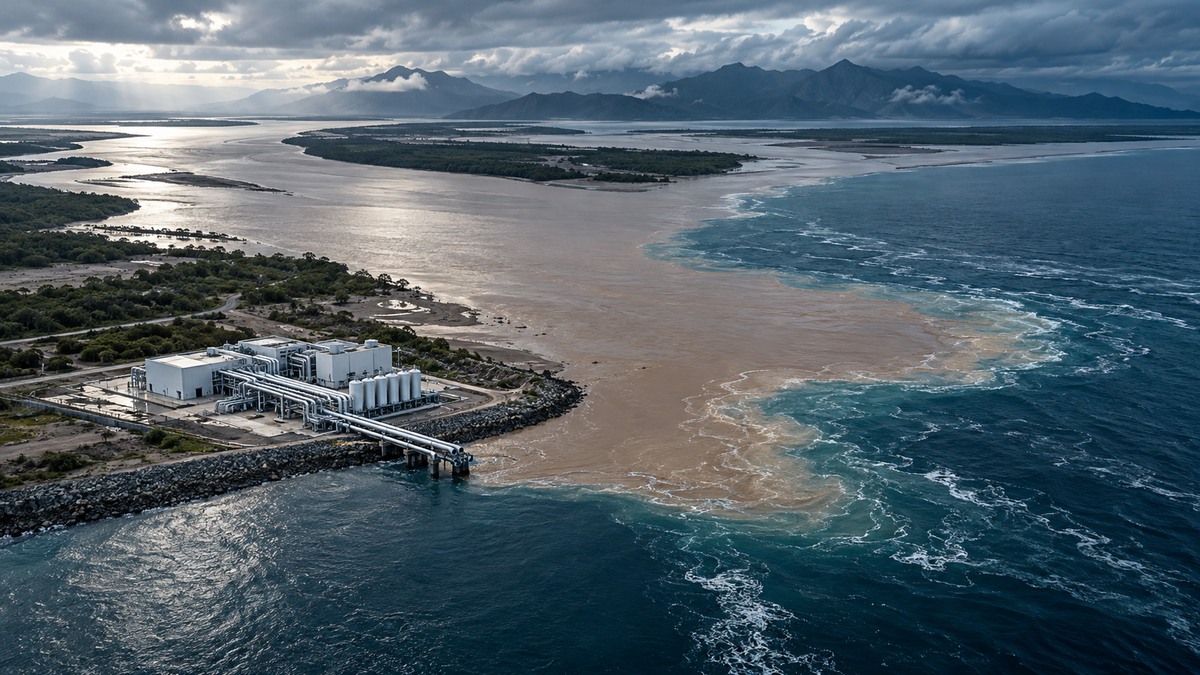
Every river that reaches the sea is quietly releasing energy. Where freshwater meets saltwater, the difference in salinity represents free energy of mixing — and osmotic power, also called salinity gradient power or “blue energy,” is the technology family that converts it into electricity. What makes it worth understanding in 2026 is not novelty; the idea dates to the 1970s. It is that osmotic power produces baseload output — continuous, 24 hours a day, independent of weather — and that after a decade written off as a failed experiment, the first real plants are now running.
The physics: an invisible waterfall at every river mouth
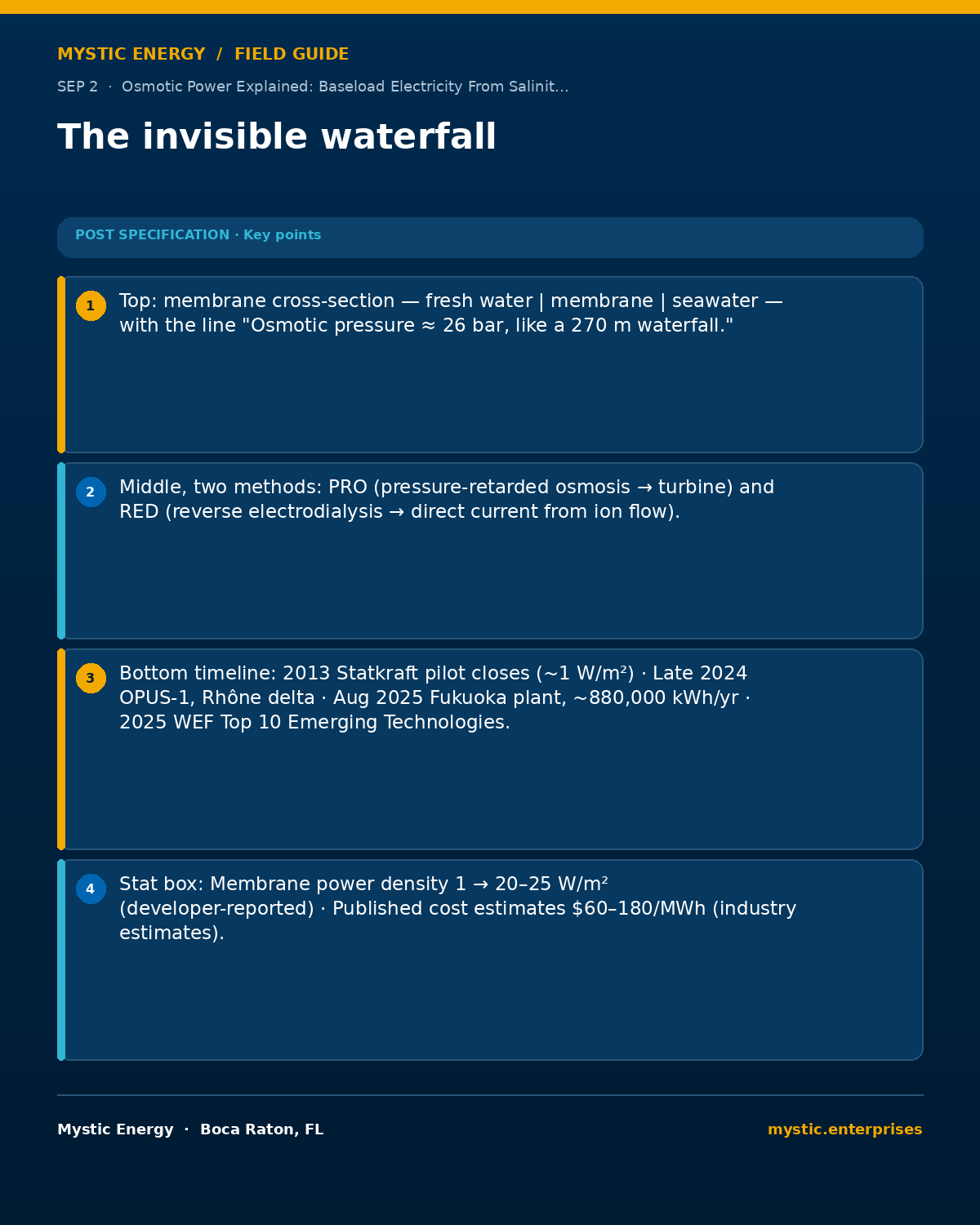
Osmosis is the movement of water across a semi-permeable membrane from the less salty side toward the saltier side. Put a membrane between river water and seawater and water migrates toward the salt side until pressure balances the concentration difference. That osmotic pressure is substantial — roughly 26 bar for a typical river-sea gradient, thermodynamically equivalent to the head of a 270-meter waterfall. Estuaries release this energy continuously; an osmotic plant is a machine for intercepting some of it. In round numbers, mixing a cubic meter of freshwater into seawater makes about 0.8 kWh of work available — and concentrated industrial brines, at multiples of seawater salinity, deliver several times more. (The energy glossary covers osmosis, salinity gradients, and related terms.)
Two ways to harvest it
Pressure-retarded osmosis (PRO)
PRO converts osmotic pressure into hydraulic pressure. Freshwater permeates through a membrane into pressurized saltwater, expanding its volume; the diluted, still-pressurized stream then drives a hydro turbine. The back end of a PRO plant is essentially familiar hydro equipment, which matters to lenders and operators — the failure modes resemble machinery the industry already understands.
Reverse electrodialysis (RED)
RED skips the turbine. Alternating ion-selective membranes let sodium ions migrate one way and chloride ions the other, and that separated ion movement generates direct electrical current across the stack — a salt battery fed continuously by fresh and salt water. RED scales by stacking cell pairs, which suits modular and distributed installations.
The nanofluidic leap
The breakthrough of the past decade is nanofluidics — a specialized form of RED using nanoscale ion channels. Research published in Nature in 2013 by Lydéric Bocquet’s group showed nanoscale channels transport ions dramatically more efficiently than conventional membranes. Sweetch Energy, the French company commercializing that work, reports power densities of 20–25 watts per square meter of membrane — roughly a 20-fold improvement over the ~1 W/m² of legacy systems — using biosourced membrane materials it says can be made at a fraction of legacy cost. Those are developer-reported figures still being validated in field operation, and they are the crux of the commercial story.
Why it failed before — and what changed
Norway’s Statkraft built the world’s first osmotic pilot and shut it down in 2013, a verdict often quoted as “osmotic power doesn’t work.” The more precise reading: it doesn’t work at 1 W/m². At that density, a single megawatt needs a million square meters of membrane — arithmetic no project survives. What changed is membrane science. With power density up an order of magnitude and membrane materials getting cheaper, the required membrane area — and with it the dominant capital cost — collapses.
The proof points arrived in 2024–2025. Sweetch’s OPUS-1 demonstrator began operating on France’s Rhône delta in late 2024 with hydropower operator CNR, the first step toward a targeted 500 MW across the delta. In August 2025, Japan opened the world’s first full-scale osmotic plant in Fukuoka — a PRO facility co-located with a seawater desalination plant, using its reject brine as the high-salinity feed and producing roughly 880,000 kWh per year. Denmark’s SaltPower runs on near-saturated underground rock-salt brine — no seawater required. And the World Economic Forum named osmotic power one of its Top 10 Emerging Technologies of 2025.
Where the economics work first
Published cost estimates for current-generation osmotic power remain wide — commonly cited at $60–$180 per MWh, with developers targeting $40–$80 by the early 2030s. Those are industry estimates for an emerging technology, not quotes. But the comparison that matters is not osmotic versus mainland solar; it is osmotic versus the firm, always-on alternatives actually available in three settings.
Desalination co-generation. Desalination plants pay to dispose of concentrated brine. An osmotic plant uses that brine as fuel, generates power, and returns a diluted stream closer to seawater salinity — turning two costs into one asset. Fukuoka is the working example, and it is directly relevant to the renewable-powered desalination and purification work we cover on this site.
Industrial brine. Saltworks, chlor-alkali plants, and other operations producing concentrated brine can retrofit osmotic generation as brine-disposal arbitrage plus a power revenue stream — the SaltPower model.
Island and coastal baseload. Small island grids running on diesel commonly pay a few hundred dollars per MWh all-in while carrying fuel-price risk. For those grids, a continuous renewable that needs no storage to firm it is compelling even at today’s osmotic cost estimates — which is why we track this technology closely for the Caribbean, Costa Rica, and coastal Latin America alongside the rest of the Mystic Energy platform.
The honest caveats
Osmotic power is early. Laboratory power densities have historically degraded significantly in field modules; membrane fouling and pumping loads eat into net output; the vendor base is thin; and first-of-a-kind plants tend to overrun cost estimates. The next three years of operating data from OPUS-1 and Fukuoka will determine how fast this sector scales. Our view: osmotic power is not a substitute for solar and wind — it is a strategically important baseload complement wherever water infrastructure and salinity gradients already exist, and the jurisdictions we serve are exactly where its economics work first.
Frequently asked questions
What is osmotic power in one sentence?
It is electricity generated from the energy released when fresh and salt water mix across engineered membranes — either by driving a turbine (PRO) or by generating current directly from ion flow (RED).
Is anyone actually producing power this way today?
Yes. Japan’s Fukuoka plant (opened August 2025) produces roughly 880,000 kWh per year alongside a desalination plant, France’s OPUS-1 demonstrator has run on the Rhône delta since late 2024, and Denmark’s SaltPower generates from industrial rock-salt brine.
Why does osmotic power pair so well with desalination?
Desalination produces concentrated brine that costs money to dispose of. Osmotic generation consumes that brine as its high-salinity feed, produces power, and discharges a stream closer to normal seawater salinity — improving both the economics and the environmental profile of the combined facility.
Is it competitive with solar and wind?
Not on mainland grids, and it does not need to be. Its niche is firm, continuous power for island grids, desalination-heavy coasts, and industrial brine sites — settings where the realistic alternatives are diesel or expensive long-duration storage, and where published osmotic cost estimates are already in range.
Watching blue energy so you don’t have to
Mystic Energy tracks emerging baseload technologies for the coastal and island markets where they matter first. Explore our renewable energy platform, read about desalination and purification, or contact our team to talk through long-horizon infrastructure planning for your jurisdiction. Mystic Energy — Boca Raton, FL · +1 (762) 316-5592.