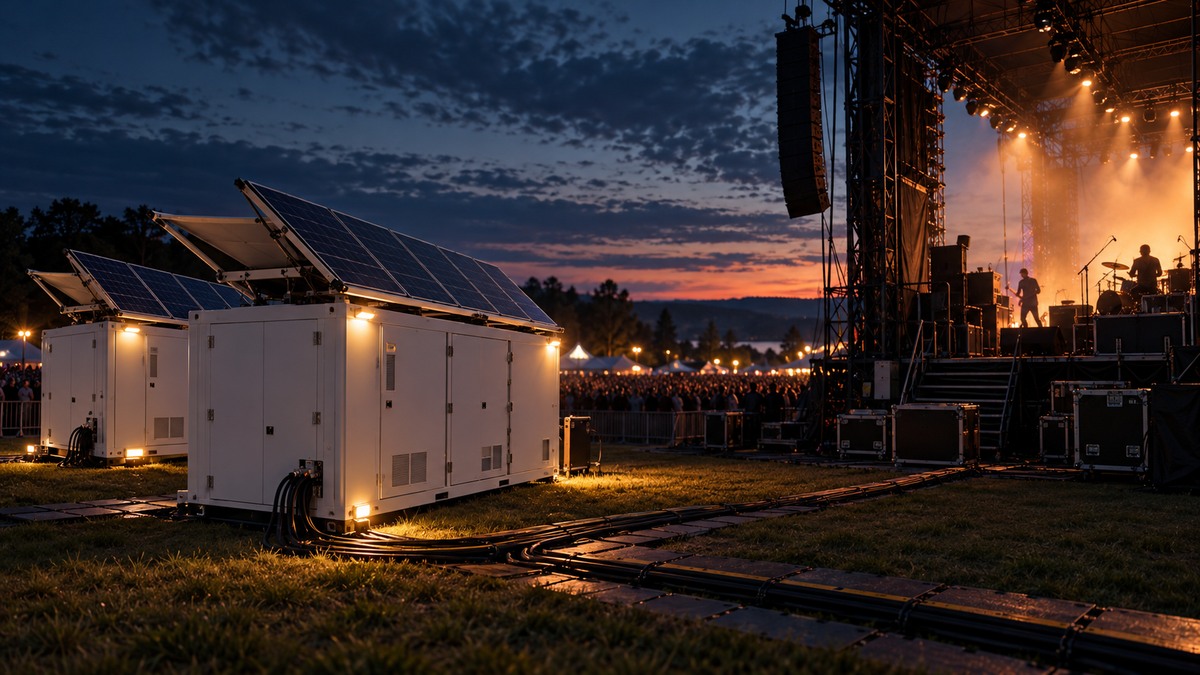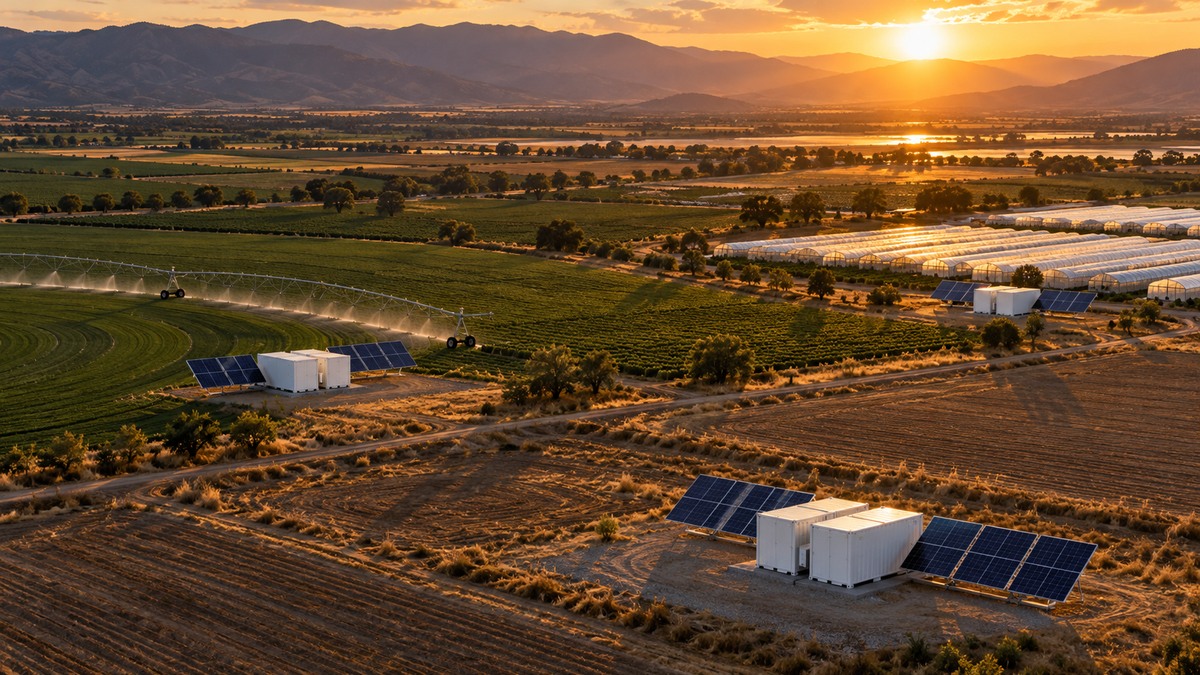
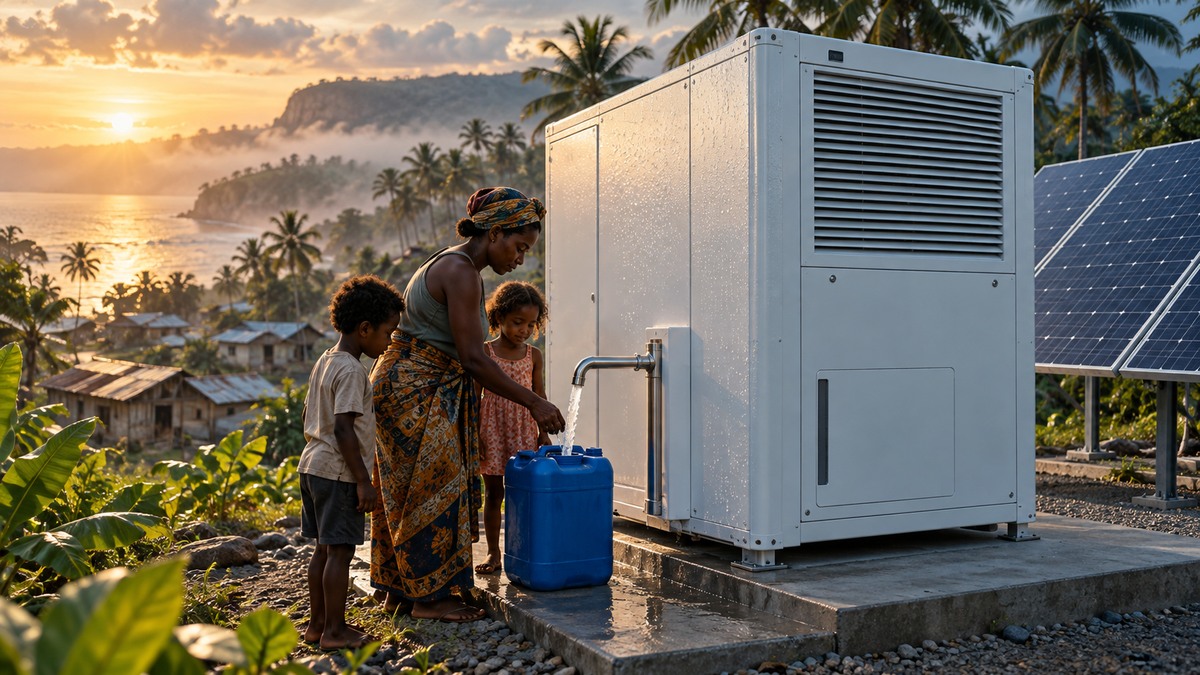
The air around you is a reservoir. Even in moderately humid weather, every cubic meter of air carries water vapor — and in the tropical and coastal markets where water stress bites hardest, it carries a lot of it. Atmospheric water generation (AWG) is the family of technologies that harvests that vapor and turns it into clean drinking water, anywhere there is air and electricity. For most of its history AWG was a niche gadget with an impossible power bill. Cheap renewable electricity is changing that — and it is worth understanding exactly how, and where, this technology earns a place in a water-security portfolio.
How machines pull water from air
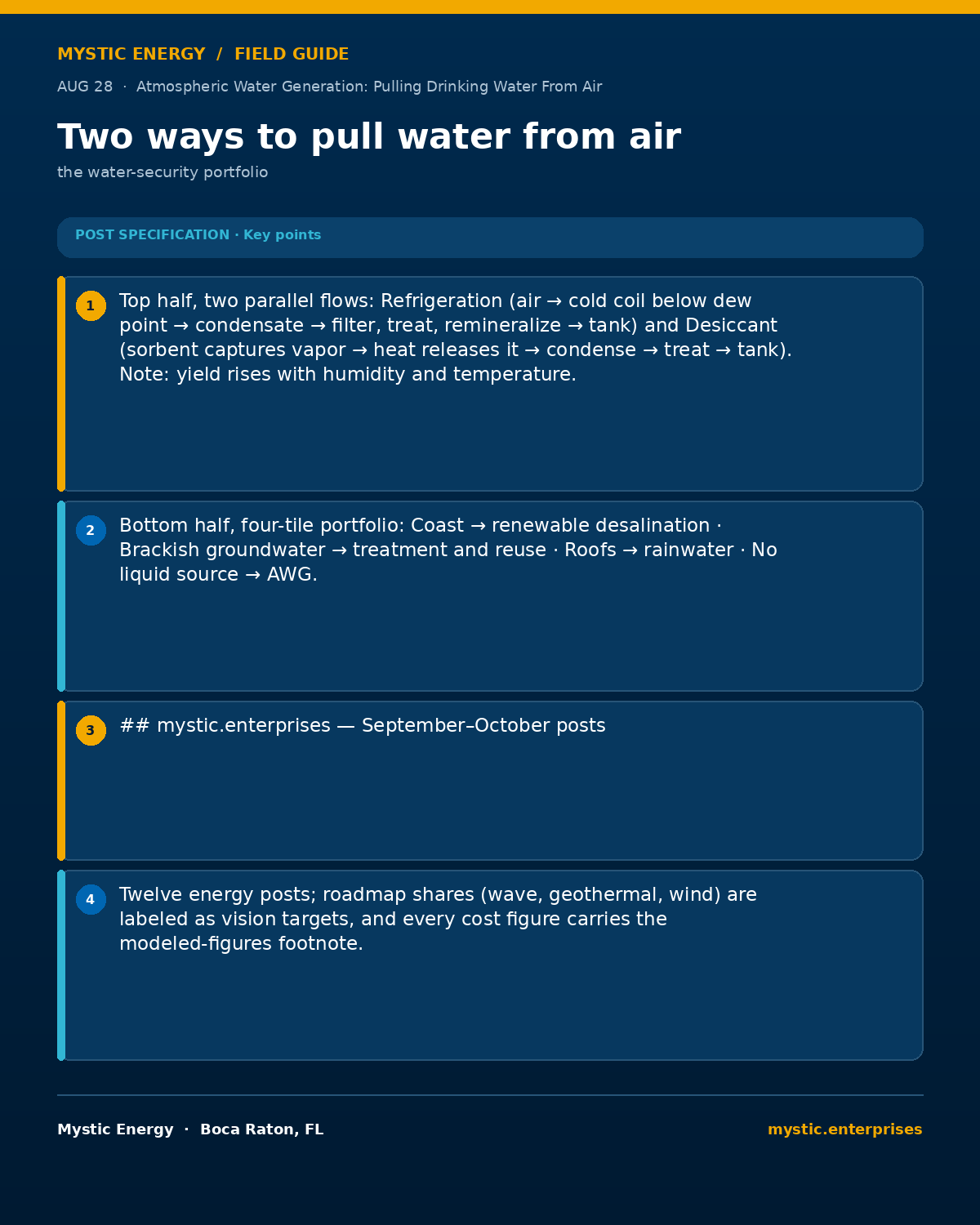
AWG systems come in two main families. Refrigeration-based systems work like a dehumidifier engineered for drinking water: air is drawn across cold coils, chilled below its dew point so the vapor condenses, and the condensate is then filtered, treated, and typically remineralized before storage — because safe drinking water is a treatment train, not just a puddle of condensate. Desiccant, or sorption-based, systems take the other route: hygroscopic materials capture water vapor directly from the air, then release it as concentrated moisture when heated, which extends useful operation into drier air than condensation alone can economically serve.
The honest physics: humidity, temperature, and the power bill
AWG output is a function of the air you give it. Yield rises with humidity and temperature — which makes the humid tropics, the Caribbean, and coastal Latin America close to ideal territory — and falls as air dries out. And there is no way around the core thermodynamics: condensing vapor into liquid takes real energy, which is why energy per liter is the number that decides whether an AWG project makes sense. Producing water from vapor generally takes substantially more energy per liter than treating water that is already liquid, such as desalinating seawater or treating brackish groundwater. AWG is therefore not a desalination replacement. It is the tool for places liquid sources cannot reach.
Why renewable power rewrites the economics
Because electricity dominates AWG’s operating cost, the price of power effectively sets the price of the water. Run an AWG unit on an island diesel grid and the water is expensive. Run it on on-site solar with battery storage — generation at near-zero marginal cost, with storage carrying production through the evening — and the same machine produces water at a fraction of the operating cost. In our platform modeling, pairing AWG-class loads with containerized solar-plus-storage follows the same logic as any steady, predictable load on the Mystic Energy platform; the resulting cost figures are modeled illustrations rather than quotes, and a site assessment replaces the model’s assumptions with your actual humidity profile, loads, and tariffs. The strategic point stands either way: as solar-plus-storage costs keep falling, technologies whose main input is electricity — desalination, purification, and AWG alike — keep getting cheaper to run.
Where AWG fits in a water-security portfolio
Think of water security as a portfolio, matched to geography. Coastal communities have the ocean, and renewable-powered desalination is the workhorse. Inland sites with brackish groundwater have treatment and reuse. Buildings have rainwater collection. AWG covers the gaps the others cannot: inland sites with no usable well, dispersed operations far from any pipeline, point-of-use drinking water where trucked supply is expensive or unreliable, and disaster response — because an AWG unit paired with solar and storage keeps producing drinking water when both the water mains and the power grid are down. For island and coastal jurisdictions, that combination — sun, humid air, and no dependence on damaged infrastructure — is precisely the resilience profile that matters most in the days after a storm.
Frequently asked questions
What is atmospheric water generation?
AWG is the extraction of drinking water from the water vapor naturally present in air, either by cooling air below its dew point to condense the vapor or by capturing it with desiccant materials and releasing it with heat. The energy glossary has a concise definition alongside related water-energy terms.
How much water can an AWG system produce?
It scales with humidity, temperature, and machine size — from small point-of-use units producing drinking water for a household to containerized industrial systems serving sites and communities. Output claims only mean something relative to stated air conditions, so any serious project starts from the site’s actual humidity profile.
Is water from air safe to drink?
Properly produced, yes. Condensate passes through filtration and treatment, and is typically remineralized for taste and health — the treatment train is an integral part of any credible AWG deployment, just as it is in desalination.
Is AWG cheaper than desalination?
Generally not where a liquid source is available — treating liquid water takes less energy per liter. AWG wins where there is no sea, no usable well, and no pipeline, or where infrastructure independence itself is the requirement. The two are complements in a portfolio, not competitors.
Water strategy is energy strategy
Whether the source is the sea, the ground, or the air itself, the cost of clean water increasingly reduces to the cost of clean power. Explore our desalination and purification work, see the renewable platform that powers it, or contact our team to scope a water-security assessment for your site or jurisdiction. Mystic Energy — Boca Raton, FL · +1 (762) 316-5592.