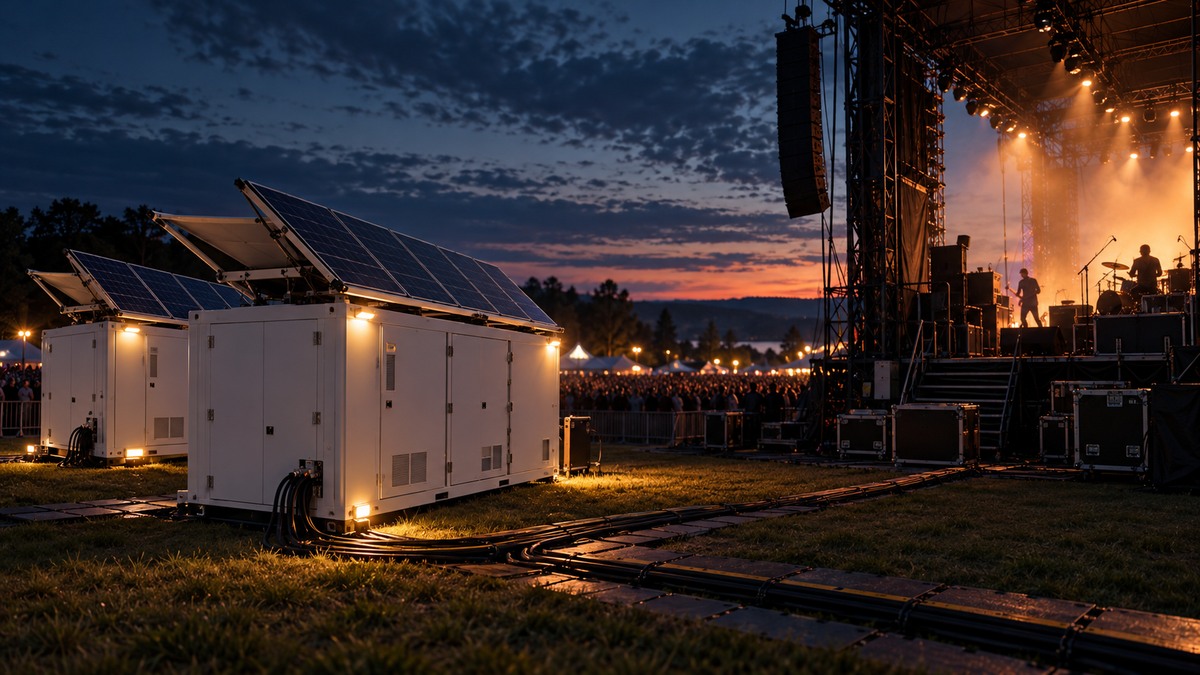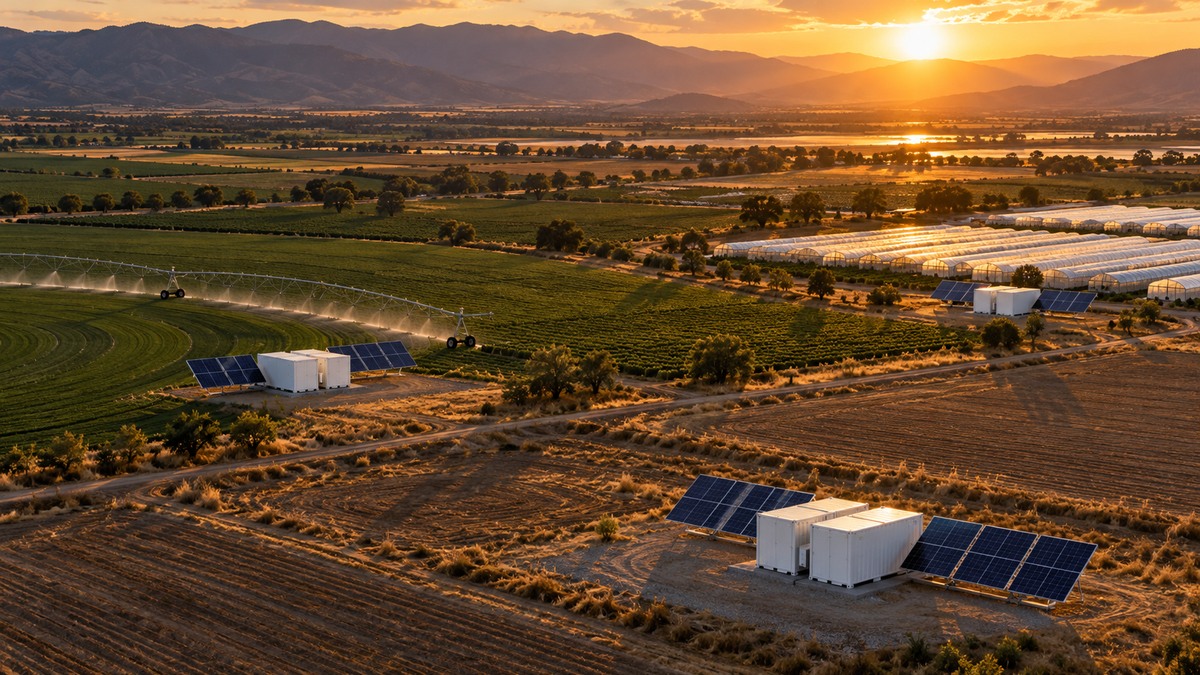
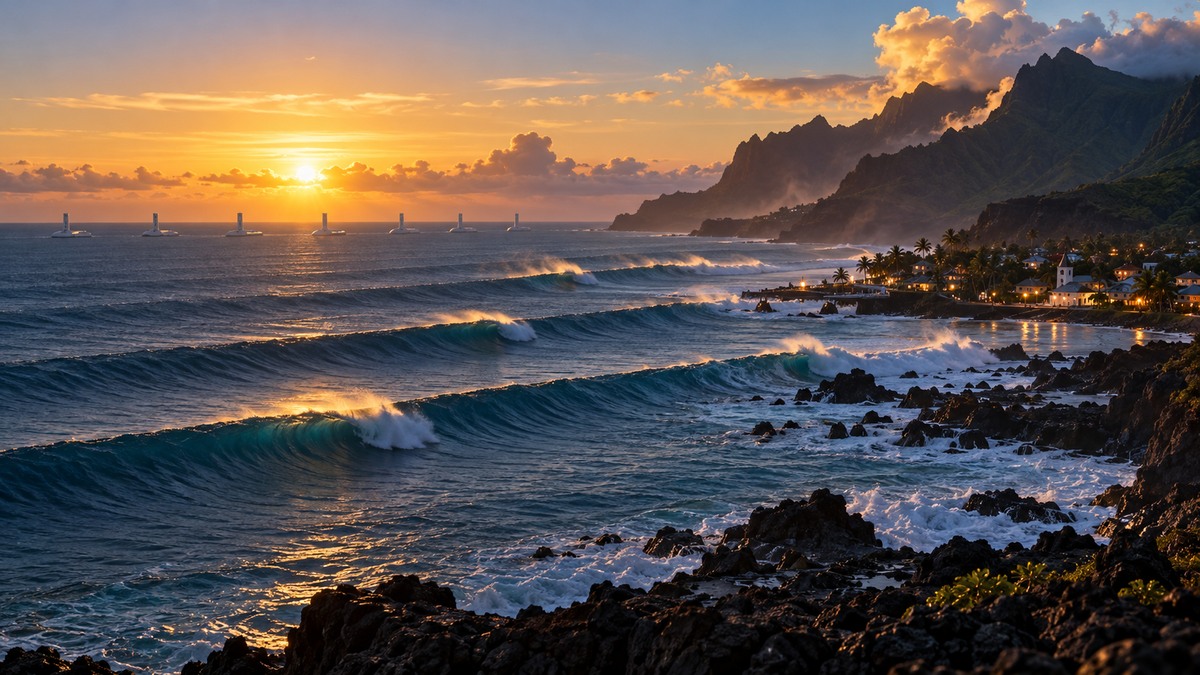
Every island utility manager knows the same arithmetic. Imported diesel sets the price of every kilowatt-hour, solar output falls off a cliff at sunset, and the one resource the island has in unlimited supply — the ocean surrounding it — contributes almost nothing to the grid. Wave energy is the technology aimed at that last line, and it is the least understood entry in the renewable portfolio. Here is what it actually offers, what it does not, and where it fits in a serious island or coastal energy mix.
The resource: thousands of kilometers, largely untapped
Central and South America and the Caribbean sit between two oceans. Thousands of kilometers of Pacific and Atlantic coastline carry consistent, predictable wave energy potential that remains largely untapped — and recent resource assessments, including the U.S. Department of Energy’s wave energy mapping work, indicate significantly higher potential along Americas coastlines than earlier estimates suggested. For an island nation, that is not an abstract statistic. It means the resource is not the constraint; the development pipeline is.
What makes wave different from solar and wind
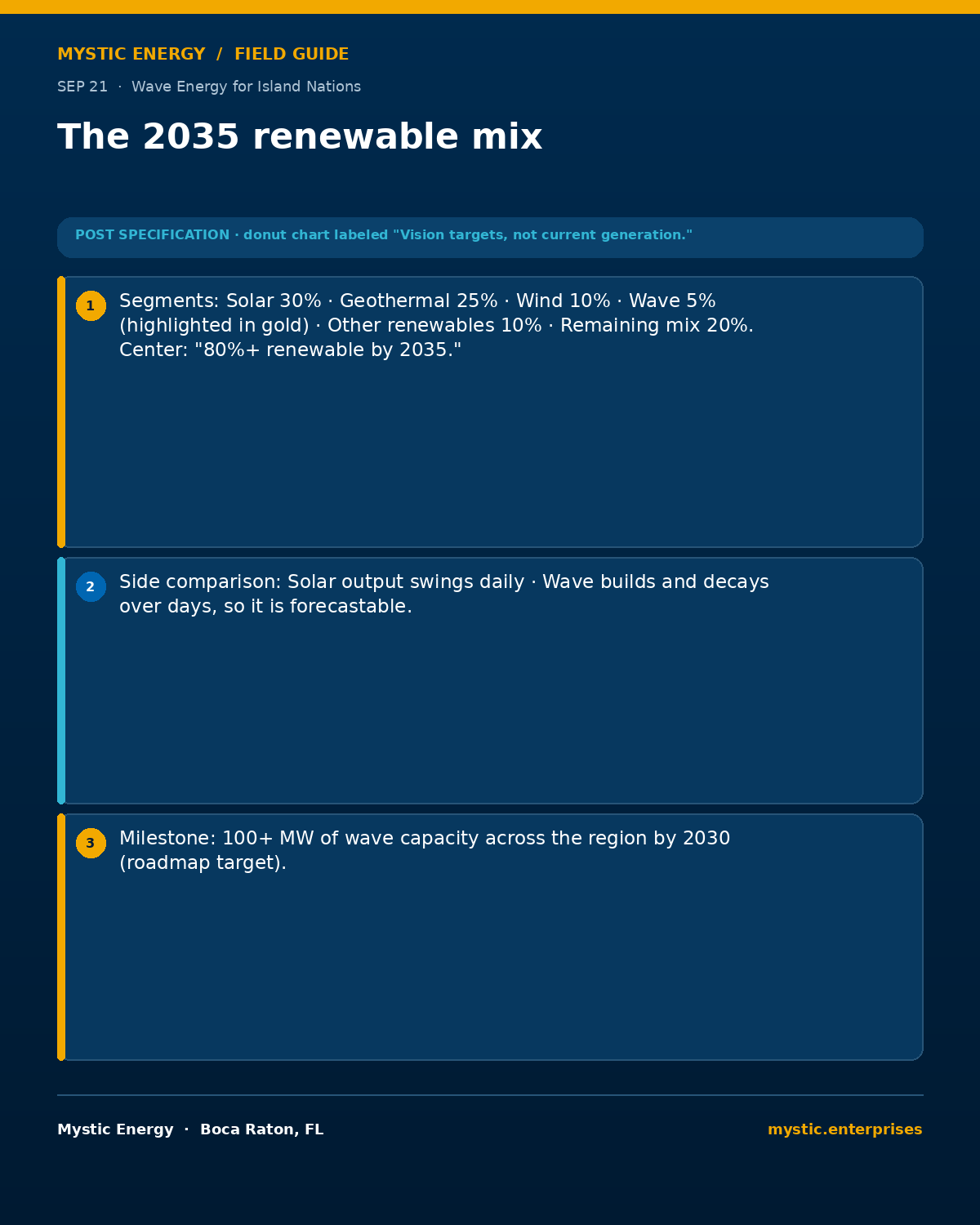
The defining characteristic of wave energy is not its size — it is its predictability. Solar output swings daily and with cloud cover; wind swings hour by hour. Ocean swell, by contrast, builds and decays over days, driven by weather systems far offshore, which means wave output is forecastable and steady over daily and weekly timescales in a way the other variable renewables are not.
Two practical consequences follow. First, steadier generation means lower storage requirements for the same reliability: a resource that does not vanish at sunset asks less of the battery fleet than one that does. That does not make storage unnecessary — hybrid systems still benefit from it — but it changes the sizing math. Second, predictable output is what export commitments require. A nation planning to sell surplus power across a regional interconnect needs generation it can promise days ahead, and wave is one of the few renewables built that way.
Where it fits: a deliberate 5% with an outsized job
Mystic’s Becoming a Green Energy Superpower by 2035 roadmap sketches a full-spectrum renewable mix for partner nations in the region: roughly 30% solar, 25% geothermal, 10% wind, 5% wave, and 10% other renewables, with total renewable generation above 80% by 2035. Those percentages are vision and roadmap targets, not current generation figures — the paper builds them from sources including IRENA’s 2024 renewable statistics, the IEA’s Renewables 2024 outlook, and Ember’s Latin America electricity reporting.
Wave’s 5% share looks modest next to solar’s 30%, and that is by design. Solar carries the bulk of new capacity because it is the fastest and cheapest to deploy; wave earns its slice by being the predictable coastal margin that firms up the variable majority. The roadmap’s nearer-term marker is 100+ MW of wave capacity by 2030 across the region — again, a roadmap target, not a build commitment.
The wind pairing: shared steel, shared wires
The strongest economic argument for wave is that it rarely has to stand alone. Offshore wave and wind development can share platforms, transmission runs, and grid connection points, and splitting that infrastructure across two generation sources materially reduces the cost of both. The same roadmap targets 200+ MW of wind per partner country by 2030, and the global context supports the pairing: the worldwide wind sector added 113 GW in 2023 alone, with Latin America contributing 36 TWh of generation growth, per the industry data the roadmap cites. Planning offshore wind and wave as one integrated coastal program — rather than two competing ones — is how the capital expenditure pencils.
What comes first: feasibility, not hardware
Wave energy is earlier on the maturity curve than solar or wind, and honest planning treats it that way. The roadmap’s recommendation is not to order equipment — it is to fund comprehensive feasibility studies of each nation’s coastline, so wave resource, grid access, and port infrastructure are mapped before capital is committed. Mystic Enterprises has expressed interest in pioneering wave development regionally, and the roadmap pairs that with multilateral funding channels for the capital-intensive stages. For governments and utilities, the near-term ask is small and specific: measure the resource properly, and design the offshore wind program so wave can plug into it later. Our energy glossary covers wave energy, baseload, and the rest of the vocabulary.
Frequently asked questions
Is wave energy proven at commercial scale?
It is earlier-stage than solar or wind — which is why the roadmap leads with feasibility studies rather than deployment targets alone. The resource assessments are strong; the engineering track record is still being built, and planning should reflect that honestly.
Does wave energy eliminate the need for battery storage?
No. Its steadiness over daily and weekly timescales reduces how much storage a grid needs for a given reliability level, but hybrid systems pairing generation with storage remain the robust design for island grids.
How much wave capacity is the region targeting?
The 2035 roadmap marks 100+ MW of wave capacity by 2030 across partner nations, within a mix that reaches 80%+ renewable generation by 2035. These are vision targets from the roadmap, not contracted projects.
Why does the roadmap give wave only 5% of the mix?
Because the job assigned to wave is quality, not quantity: a predictable, forecastable coastal contribution that firms up a mix dominated by cheaper but more variable solar. The share is small; the reliability role is not.
Plan the coastline into your energy mix
If your nation, utility, or island development is weighing a renewable portfolio, the ocean at your shoreline deserves a line in the study. Explore the Mystic Energy platform or contact our team to talk through a full-spectrum assessment. Mystic Energy — Boca Raton, FL · +1 (762) 316-5592.