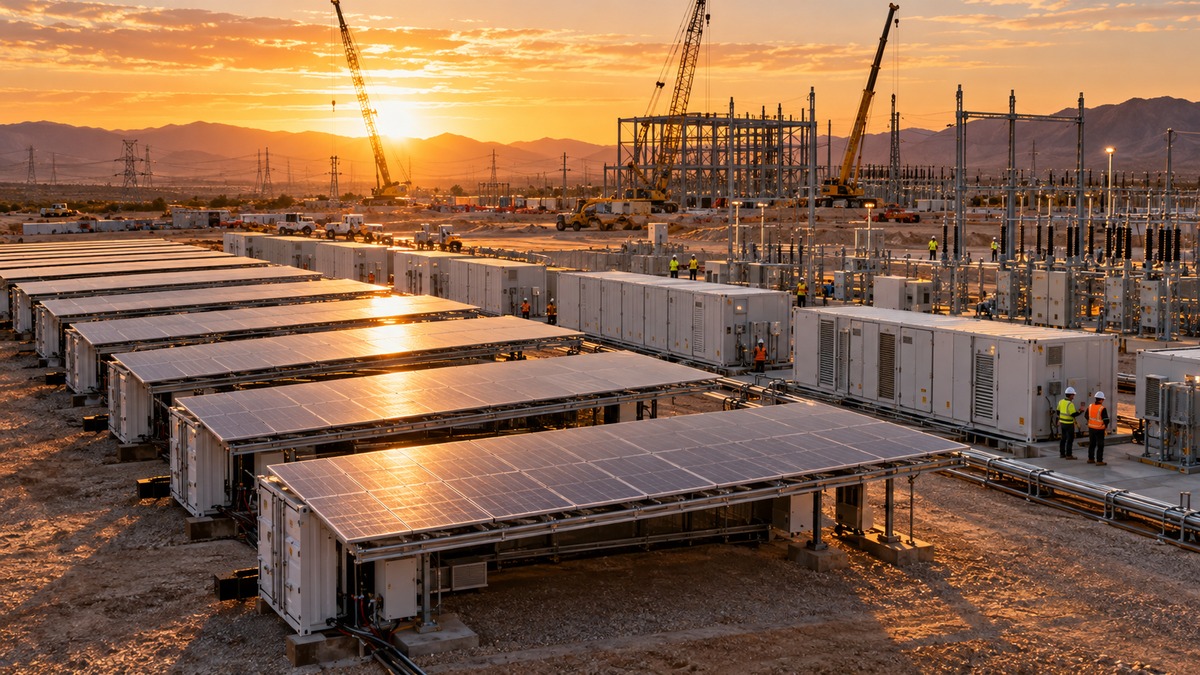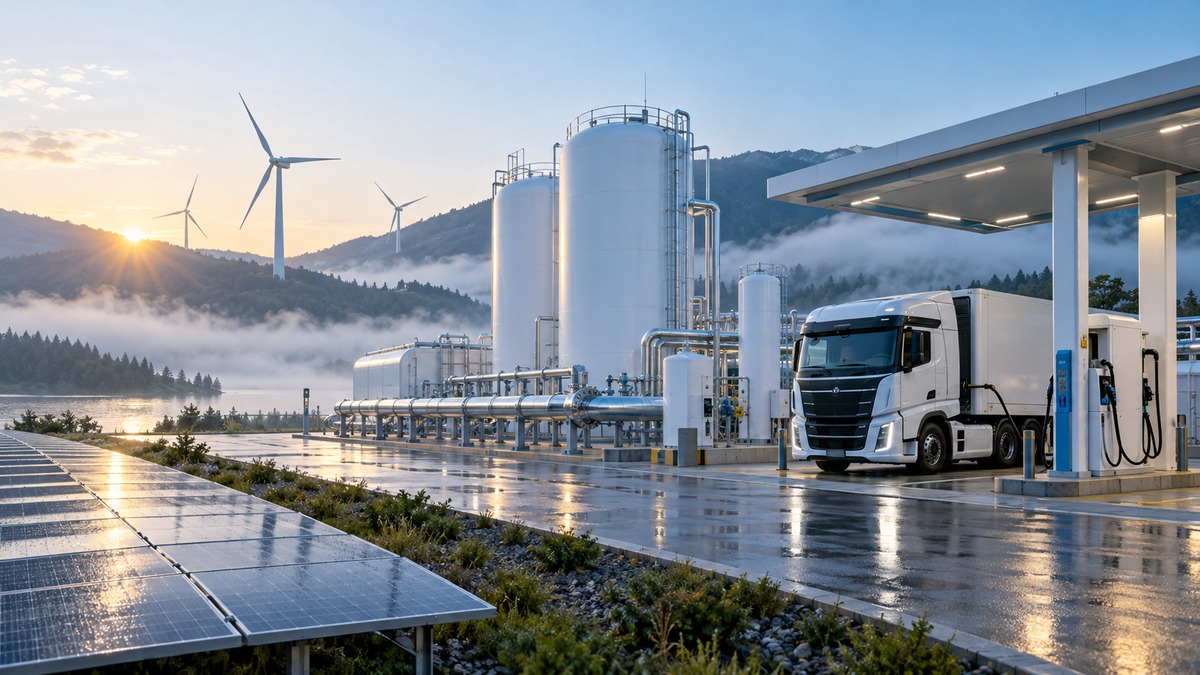
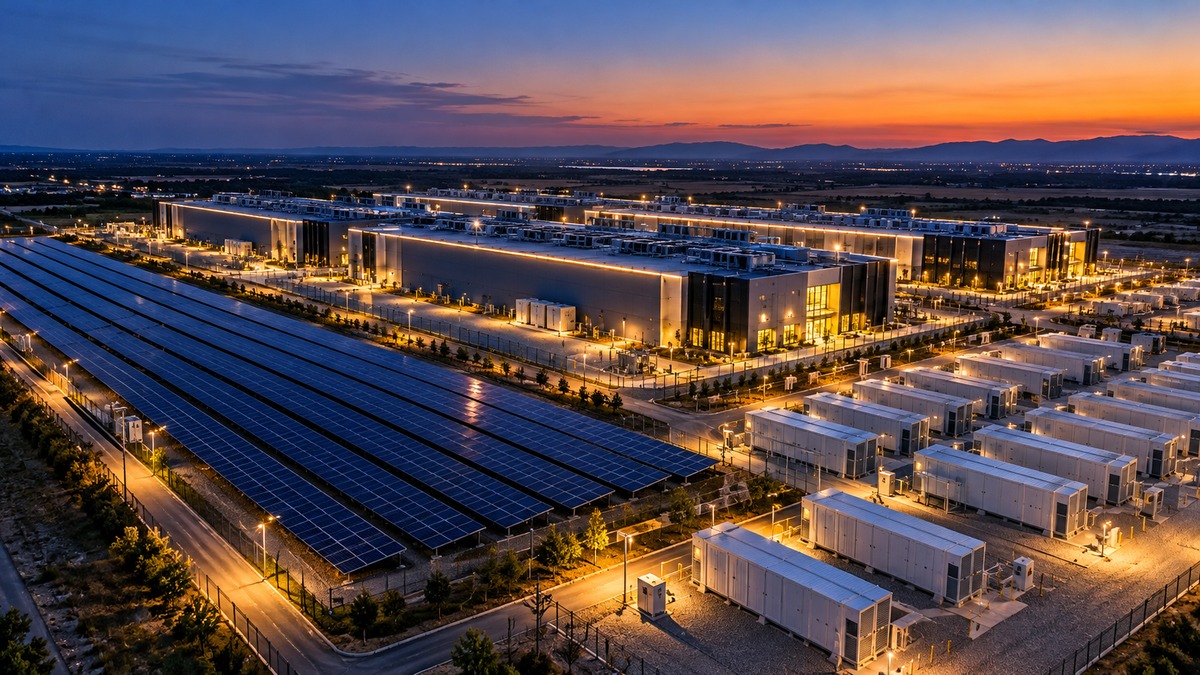
The fastest-growing electrical loads in North America are also the least patient ones. Data centers want hundreds of megawatts on timelines measured in quarters; the interconnection queues offering that power run in years. For a while, the default answer was new gas capacity. That default has quietly expired. BloombergNEF now finds that co-located solar paired with four-hour battery storage can meet a substantial share of data-center electricity demand at a lower cost than new gas generation in regions like California and parts of Texas — and that the gap widens as solar output expands and storage prices fall. For the broader class of commercial, industrial, and institutional off-takers, that finding changes the starting point of every power conversation.
The load profile that storage was built for
Data centers, hospitals, universities, cold-storage warehouses, and manufacturing facilities share three traits that make them the natural clients for commercial battery energy storage. They run high load factors, so every installed kilowatt works hard. They have close to zero tolerance for outage — downtime is measured in lost production, spoiled inventory, or patient risk rather than inconvenience. And increasingly they carry explicit carbon-reduction mandates from boards, customers, or regulators that a diesel backup fleet actively violates. High utilization, high reliability requirements, and a decarbonization mandate is precisely the combination co-located solar-plus-storage serves.
What “cheaper than new gas” rests on
The economics behind the BloombergNEF finding are not a one-off. Global average turnkey battery system prices fell to roughly $117 per kilowatt-hour in 2025 — a 31 percent year-over-year decline and the lowest level on record, a shift we unpacked in our post on what $117/kWh batteries mean. Ember’s analysis, cited in our white paper alongside it, puts dispatchable solar-plus-storage at roughly $76 per megawatt-hour — cheaper and faster to build than equivalent gas capacity in a growing set of markets. Those are market benchmarks from third-party analysts, not Mystic quotes; the point is the direction and durability of the curve. Gas plants price fuel risk for thirty years. Solar-plus-storage prices sunshine and a hardware curve that has fallen every year since 2021.
Three jobs behind the meter
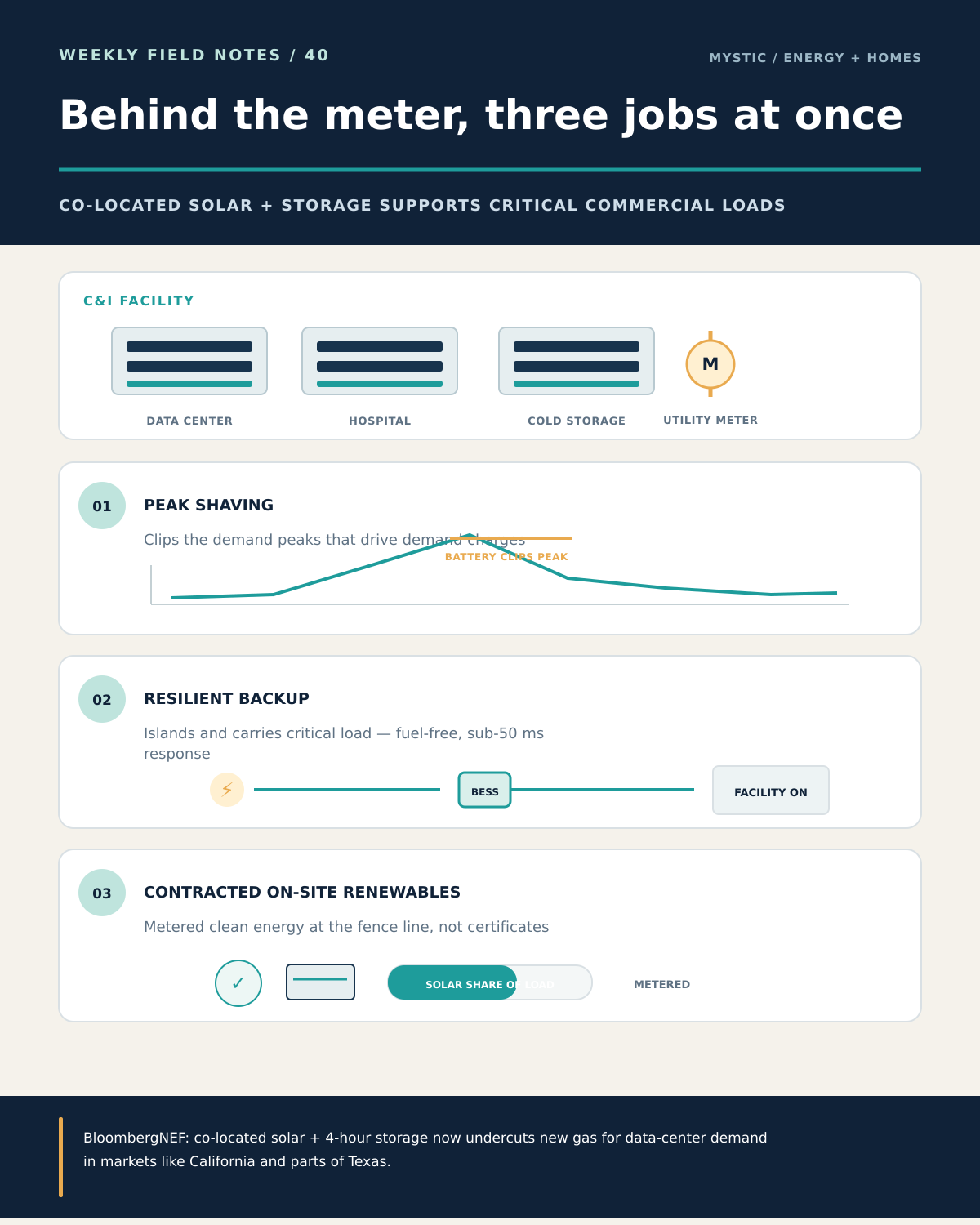
Deployed behind the meter, a hybrid solar-plus-storage node earns its keep in three ways at once. First, peak shaving: the battery clips the demand peaks that drive a C&I facility’s demand charges, the same mechanics we covered in behind-the-meter versus front-of-the-meter storage. Second, resilient backup: when the grid drops, the system islands and carries critical load — fuel-free, silent, and without the fuel-logistics exposure a generator fleet inherits in exactly the weather that causes outages. Third, a contracted share of load from on-site renewables: measurable megawatt-hours of clean energy delivered against the facility’s carbon mandate, metered at the fence line rather than bought as certificates.
Speed is the quiet differentiator
A conventional utility-scale project takes two to five years from land control to commercial operation; interconnection queues, permitting, and construction all compound. Mystic Energy’s deployable hybrid nodes invert that timeline: each pairs an unfolding containerized solar array of up to 140 kilowatts peak with containerized LFP battery storage from 250 kilowatt-hours upward, is commissioned in hours rather than months, and scales by multiplication — more nodes, more capacity, no redesign. For an off-taker whose load is arriving faster than the grid can, capacity that is earning within weeks of a purchase order is not a convenience; it is the difference between growth on schedule and growth deferred.
Paying for it: the financing tailwind
Commercial structures run from outright purchase through capital lease to long-term on-site power purchase agreements, where the off-taker pays a contracted rate and owns nothing. One development worth noting from our white paper: ESG-linked financing is increasingly available for this class of deployment, often at pricing below conventional corporate borrowing — lenders now treat on-site clean energy as risk reduction rather than a concession. For finance teams, that means the resilience upgrade and the balance-sheet-friendly structure are no longer in tension.
Frequently asked questions
Is solar-plus-storage really cheaper than gas for a data center?
In a growing set of markets, yes — BloombergNEF finds co-located solar and four-hour batteries can meet a substantial share of data-center demand at lower cost than new gas in regions like California and parts of Texas, with the gap widening. The honest answer for any specific site is a scoped analysis of local tariffs, land, and load shape rather than a headline number.
Can a battery actually back up a critical facility?
Behind the meter, the system islands during outages and carries the contracted critical load, with sub-50-millisecond response. Sizing determines duration: storage scales from a 250 kWh base configuration to multi-megawatt-hour deployments by adding containers, and many facilities retain existing generators as deep backup while the hybrid system handles everything short of the worst case.
What does “co-located” change versus buying clean power off the grid?
Co-location removes the transmission bottleneck — the energy is generated, stored, and consumed on the same site, so it does not wait in an interconnection queue or incur delivery losses. It also makes the carbon accounting direct: the facility’s clean share is metered on site, not matched on paper.
What is the first step for a C&I site?
A load-profile review: twelve months of interval data, the facility’s outage tolerance, and its carbon commitments. From there, sizing and a financial model follow in weeks. Our energy glossary covers the vocabulary that shows up along the way.
Put the fence line to work
If your load is growing faster than your utility’s queue, the economics now favor generating and storing on site. Explore our renewable energy practice, or contact our team to scope a co-located system against your interval data. Mystic Energy — Boca Raton, FL · +1 (762) 316-5592.