Ask what backup power costs and most people quote the price of a generator. That number is real — and it is the smallest number in the equation. The honest comparison between diesel generators and solar-plus-storage is a total-cost-per-kilowatt-hour comparison over the life of the asset, and once you run it that way, the result is hard to argue with.
The sticker price is the smallest number
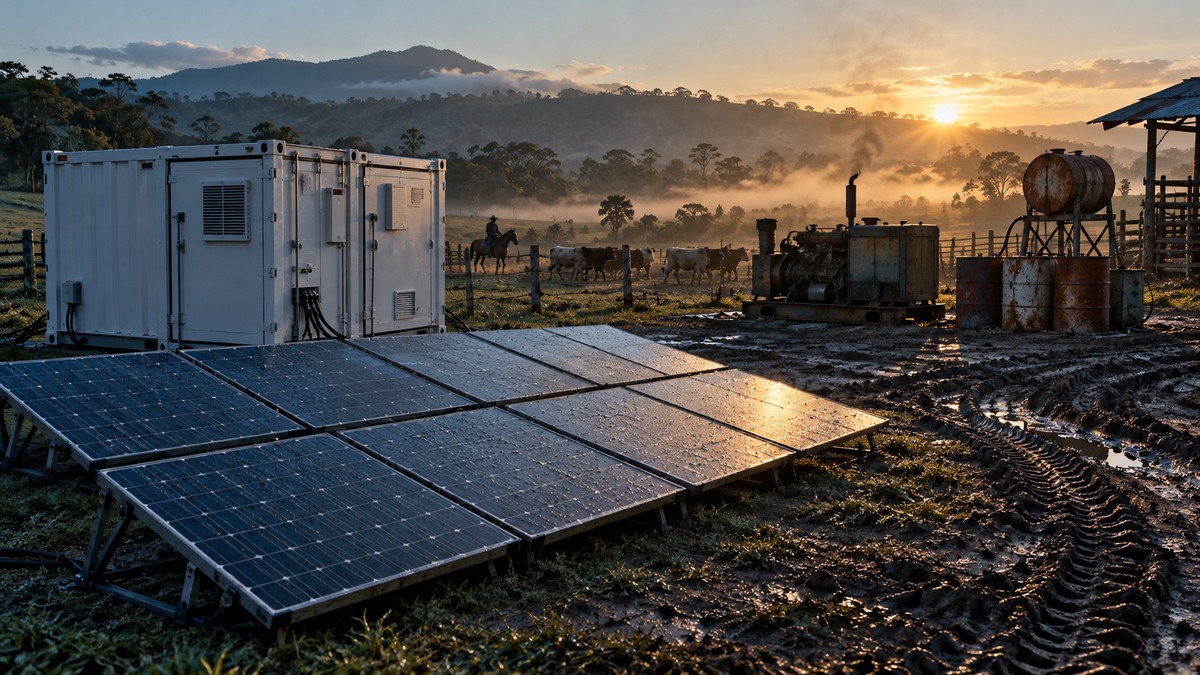
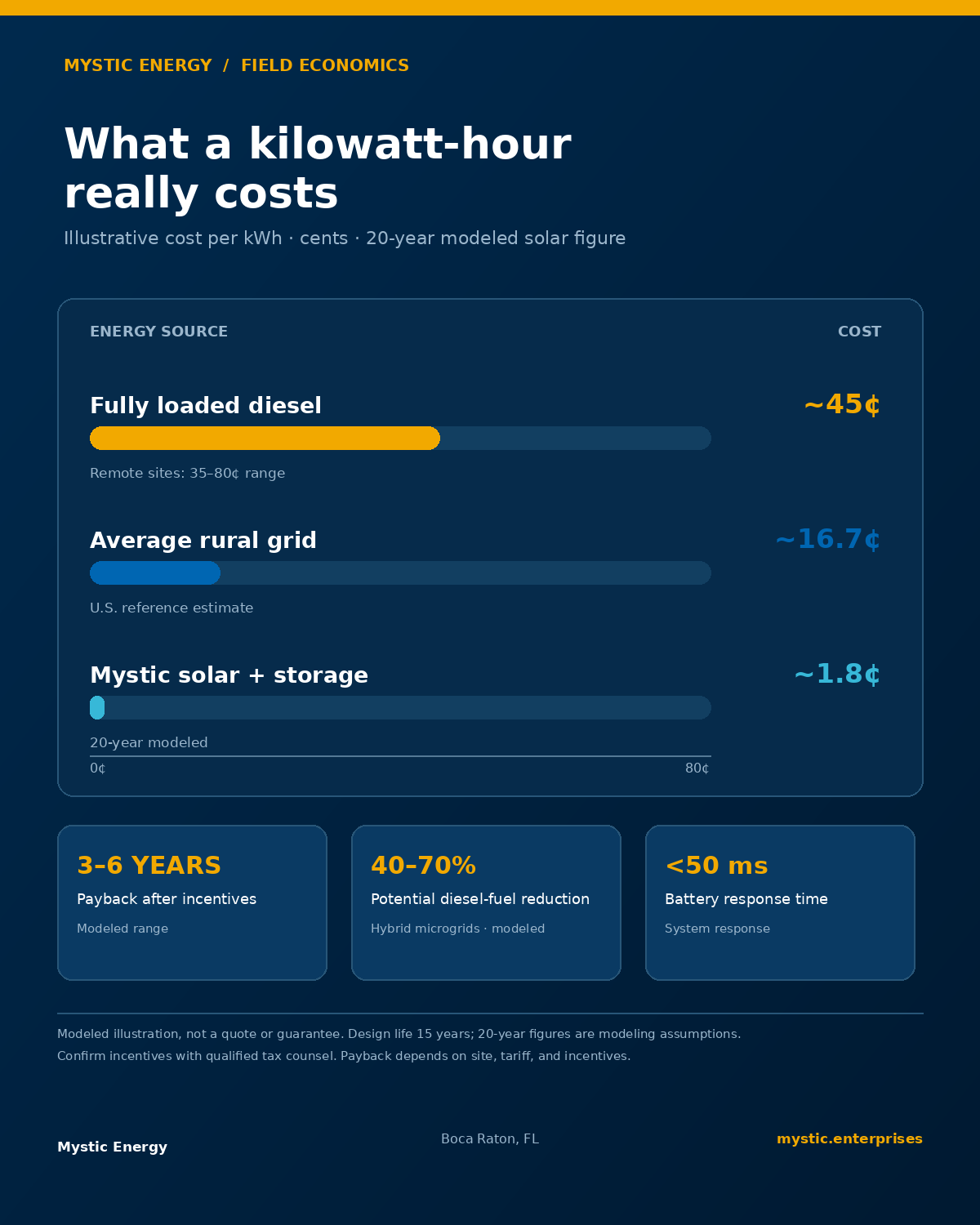
A diesel generator’s purchase price buys you a machine, not electricity. The electricity costs extra, forever: fuel at volatile prices, fuel delivery to wherever you are, oil and filter service, load-bank testing, emissions compliance, and downtime when any link in that chain breaks. For remote and industrial sites, fully loaded diesel power typically lands between $0.35 and $0.80 per kilowatt-hour once fuel, logistics, maintenance, and compliance are counted — and in our farm and ranch modeling, a fully loaded figure around 45¢/kWh is representative.
Worse, the fuel chain fails exactly when you need it most. The same hurricane that takes down the grid closes the roads the fuel truck drives on. A generator with an empty tank is a lawn ornament.
What solar-plus-storage costs — a modeled comparison
Solar-plus-storage inverts the cost structure: nearly all of the cost is upfront, and the marginal cost of each kilowatt-hour after that approaches zero. Industry benchmarks have moved decisively — global turnkey battery system prices fell to roughly $117 per kilowatt-hour in 2025, the lowest on record — and dispatchable solar-plus-storage now underprices new-build gas generation in several markets.
Mystic Energy’s deployable hybrid node pairs a fold-out solar array of up to 140 kW peak with containerized lithium iron phosphate (LFP) battery storage configurable from 100 kWh to 2 MWh, deployable in under 24 hours without foundations or interconnection waits. Our modeling for agricultural operations works out to approximately 1.8¢ per kWh delivered over a 20-year modeling horizon, against roughly 16.7¢ for the average rural grid and 45¢ for fully loaded diesel — with modeled payback of 3–6 years after incentives.
Important: these cost and payback figures are modeled illustrations for a new product line, not quotes or guarantees. The hardware’s stated design life is 15 years; 20-year figures are modeling assumptions. Actual results depend on your loads, sun resource, utility rates, and incentive eligibility — which is exactly what a site-specific assessment establishes.
Where diesel still earns its keep
An honest comparison keeps the generator in the picture. For sites with existing diesel assets, the strongest configuration is a hybrid microgrid: solar-plus-storage carries the base load and the daily cycle, while generators are retained for deep backup and rare demand peaks. In remote industrial deployments of this kind, modeled fuel savings of 40–70% are typical, with the platform paying back in roughly two to four years — again, modeled figures, not guarantees. You don’t have to scrap what you own to stop burning it every day.
Reliability: fuel-free beats fuel-fast
Batteries respond in under 50 milliseconds — fast enough to ride through a grid failure without a blink, where generators need seconds to start and stabilize. And because the “fuel” arrives daily by sunlight, there is no supply chain to fail after a disaster. Storage also earns its keep between outages through energy arbitrage and behind-the-meter demand management, something an idle generator can never do.
The incentive window is a real deadline
U.S. commercial solar projects must generally have begun construction by July 4, 2026, or be placed in service by December 31, 2027, to capture the full 30% federal Investment Tax Credit — while standalone battery storage retains its 30% credit on a longer runway, through 2032. Incentive stacking (federal expensing, USDA REAP grants for agricultural operations, state and utility programs) can materially reduce net cost. Tax and incentive rules change and are applied case-by-case — always confirm current eligibility and timing with qualified tax counsel before making decisions.
Frequently asked questions
How long can a battery carry my operation through an outage?
That is a sizing question, not a technology question. Storage is configurable from 100 kWh to multi-megawatt-hour deployments, and the paired solar array recharges it daily — so a correctly sized system carries the night and refills by day, indefinitely, rather than counting down a fuel tank.
Do I have to get rid of my existing generators?
No. Many deployments run as solar-diesel-storage hybrids, with generators demoted to deep backup. You keep the insurance and lose most of the fuel bill.
What does “fully loaded” diesel cost mean?
The real cost per kilowatt-hour once fuel, delivery logistics, maintenance, compliance, and downtime are included — not just the pump price. For remote sites this typically runs $0.35–$0.80/kWh.
Are the savings figures guaranteed?
No — they are modeled illustrations based on stated assumptions. We publish them so you can interrogate the model, and a site-specific assessment replaces the model’s assumptions with your actual loads, rates, and incentives.
Run the numbers on your site
The comparison only becomes real when it uses your loads and your fuel bills. Learn how our containerized systems work on the commercial battery storage page, see the wider renewable energy platform, or request a site-specific assessment and we’ll model your operation. Mystic Energy — Boca Raton, FL · +1 (762) 316-5592.